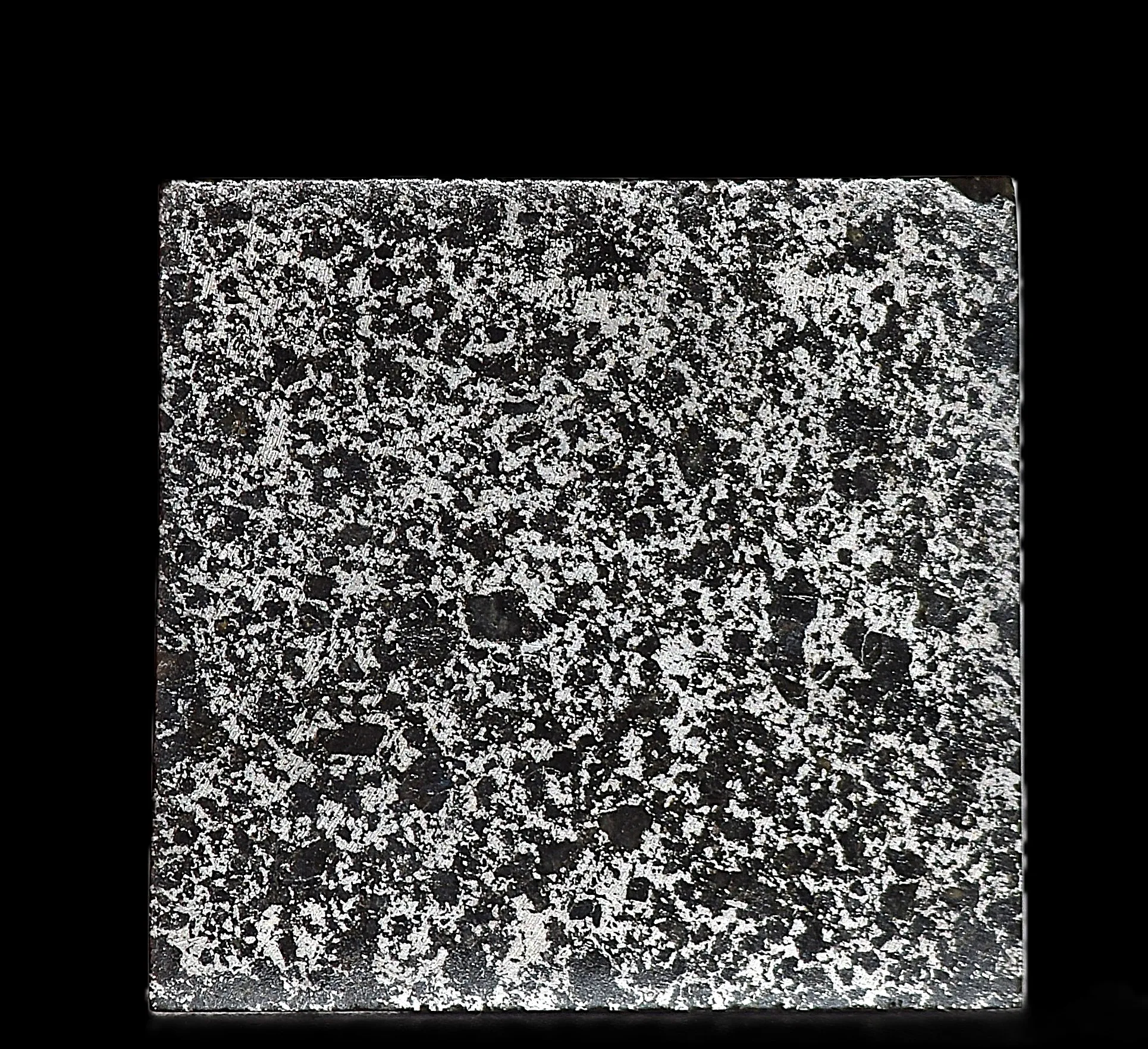
Polished 9 g slice of Tanezrouft 091 revealing the intricate silicate-metal matrix.
Name: Tanezrouft 091
Classification: Mesosiderite A3, stony-iron meteorite
Origin: Differentiated planetary parent body
Total Known Weight: approximately 4.99 kg
Found: Near Adrar, Algeria
Year of Find: 2020
Tanezrouft 091: Petrological and Geochemical Analysis
Tanezrouft 091 is an officially recognized mesosiderite whose significance lies particularly in its complex brecciated structure and the combination of metallic and silicate components. Its classification is based on mineralogical, petrographic, and geochemical investigations that provide insights into the thermal and structural evolution of its parent body. The documented total mass is 4,988 g, distributed between two originally recovered stones. The meteorite became known in 2020 and was officially recognized on December 5 of that year.
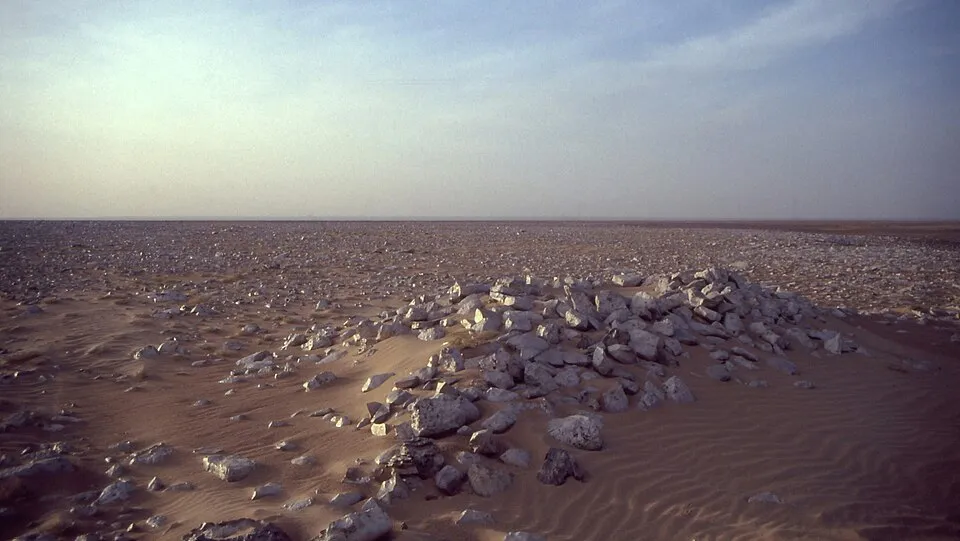
Tanezrouft Desert, Mali (1990)
Petrological Composition and Internal Structure
Mesosiderites belong to the stony-iron meteorite group. They are characterized by the coexistence of metallic iron-nickel phases and silicate rock components. Unlike many iron meteorites, their structure does not consist predominantly of a continuous metallic framework. Instead, metal and silicate occur together in a complex, brecciated assemblage.
This structure is particularly pronounced in Tanezrouft 091. The examined sections reveal a breccia containing metallic grains, rounded metal nodules measuring several centimeters, and silicate rock fragments reaching up to 4 cm in size. Individual mineral grains can measure up to 0.5 cm. The metal nodules are locally prominent and form a distinct contrast with the silicate components.
The petrographic investigation also describes rock fragments with cumulate and brecciated textures embedded in a matrix composed of orthopyroxene, plagioclase, other silicates, and metal. The metal content of this matrix is reported to be approximately 35 vol%. These measurements refer to the examined sample and should not automatically be interpreted as the exact composition of every fragment of Tanezrouft 091.
Mineralogical Composition and Geochemical Signatures
The silicate component of Tanezrouft 091 is dominated by orthopyroxene and plagioclase. It also contains olivine and a silica phase. Quantitative analysis of 20 backscattered-electron images yielded the following relative proportions within the investigated silicate fraction: orthopyroxene accounts for approximately 60 vol%, plagioclase for 31 vol%, olivine for 5 vol%, and the silica phase for 4 vol%. This distribution demonstrates that pyroxene and feldspar dominate the silicate fraction. These values refer to the analyzed silicate fraction rather than to the meteorite as a whole.
In addition to these major minerals, kamacite and taenite were identified as iron-nickel phases, together with apatite, troilite, chromite, and traces of ilmenite. The metallic phases, combined with the silicates, form the meteorite’s characteristic heterogeneous structure.
The chemical compositions of the silicate minerals provide further information about their formation and subsequent alteration. The analyzed olivines have a mean fayalite content of Fa₃₆.₆ ± 7.7. Different compositions were determined for low-calcium pyroxenes occurring in zoned crystals and in the matrix. The measured values are Fs₃₀.₈ ± 2.5 Wo₂.₁ ± 0.7 for zoned low-calcium pyroxenes and Fs₃₇.₅ ± 1.3 Wo₃.₂ ± 0.1 for matrix pyroxenes. High-calcium pyroxenes have a composition of Fs₁₈.₁ ± 1.7 Wo₄₀.₆ ± 4.2. The plagioclase has an anorthite content of An₉₂.₄ ± 0.4, making it highly anorthite-rich.
Fa denotes the fayalite component in olivine, Fs the ferrosilite component, and Wo the wollastonite component in pyroxene. An denotes the anorthite component of plagioclase. The differences between mineral groups and between the matrix and individual crystals are consistent with a complex petrological history. However, these differences alone do not establish a unique formation mechanism for the meteorite as a whole.
Formation Model: Collision, Mixing, and Recrystallization
The formation of mesosiderites remains one of the more complex questions in meteoritics. Their composition combines silicate rock components associated with the crust of a differentiated parent body and metallic iron-nickel that may have originated in deeper regions of such a body. The processes responsible for mixing these originally separated components are the subject of several scientific models.
One widely discussed model involves a sequence of processes. Silicate rocks first crystallized from magma within an early planetary body. Subsequent collisions fragmented and brecciated these rocks. Further impacts may then have mixed metallic material with silicate fragments. Localized partial melting, recrystallization, and subsequent cooling modified the resulting structure. Later burial into deeper regions of the parent body may have influenced its further thermal evolution.
Several features of Tanezrouft 091 are consistent with this general model, including its diverse silicate fragments, rounded metal nodules, and complex matrix. Particularly informative are the reaction rims surrounding olivine grains. Some of these rims have almost completely replaced originally distinct mineral grains. Such reaction structures document chemical interactions between minerals and their surroundings, providing evidence of subsequent alteration.
The recrystallized silicates and the reported exsolution structures in pyroxenes also indicate a multistage thermal history. Nevertheless, these observations alone do not establish the precise sequence of all events or conclusively determine the origin of the metal. The formation history of mesosiderites as a group remains an active subject of scientific research.
Petrological Classification: Mesosiderite A3
The detailed classification of Tanezrouft 091 is mesosiderite A3. The designation A3 contains two components that must be interpreted separately.
Class A describes a particular structural variety of mesosiderites. Its assignment takes into account factors including texture, metal content, magnetic susceptibility, and the relative proportions of orthopyroxene and plagioclase. Tanezrouft 091 was assigned to class A based on these characteristics.
The number 3 indicates the metamorphic grade. The classification was based on recrystallization textures in the silicates and the absence of pigeonite. It therefore records a particular degree of mineralogical and structural modification. It is not a direct age designation and does not mean that the meteorite underwent exactly three thermal events.
Tanezrouft 091 is also recorded as having a low shock stage and a low weathering grade. These assessments describe the condition of the examined material and should not be confused with its metamorphic classification.
Physical Characteristics and Documented Find History
The two originally documented stones of Tanezrouft 091 had a combined mass of 4,988 g. They were recovered near Adrar. The documented acquisition history begins with Carlos Muñecas Muñoz purchasing the samples from a dealer in Morocco in 2020. The acquisition location in Morocco should not be confused with the actual find location.
The original stones are described as dark brown and rounded, with no recognizable fusion crust. Rounded metal nodules protrude from the surface. This appearance differs from that of many freshly fallen meteorites, which retain a clearly visible fusion crust. However, the absence of a fusion crust alone does not establish the duration of terrestrial weathering.
Of the documented total mass, 2,525 g is recorded as the main mass. A 24.46 g slice and a polished section were deposited at Appalachian State University in the United States. These reference samples are important for the scientific traceability of the classification.
References and Further Reading
Gattacceca, J. et al. (2021). The Meteoritical Bulletin, No. 109. Meteoritics & Planetary Science, 56, 1626–1630. Official data for Tanezrouft 091.
Mayne, R. G. et al. (2023). Metal in mesosiderites: Evidence for redox and fractional crystallization. Meteoritics & Planetary Science. DOI: 10.1111/maps.14031.
Zachén, G. et al. (2025). Investigation and reclassification of four mesosiderites—Implications for their formation. Meteoritics & Planetary Science, 60, 2574–2593. DOI: 10.1111/maps.70051.
Rubin, A. E. & Mittlefehldt, D. W. (1993). Evolutionary History of the Mesosiderite Asteroid: A Chronologic and Petrologic Synthesis. Icarus, 101(2), 201–212. DOI: 10.1006/icar.1993.1018.