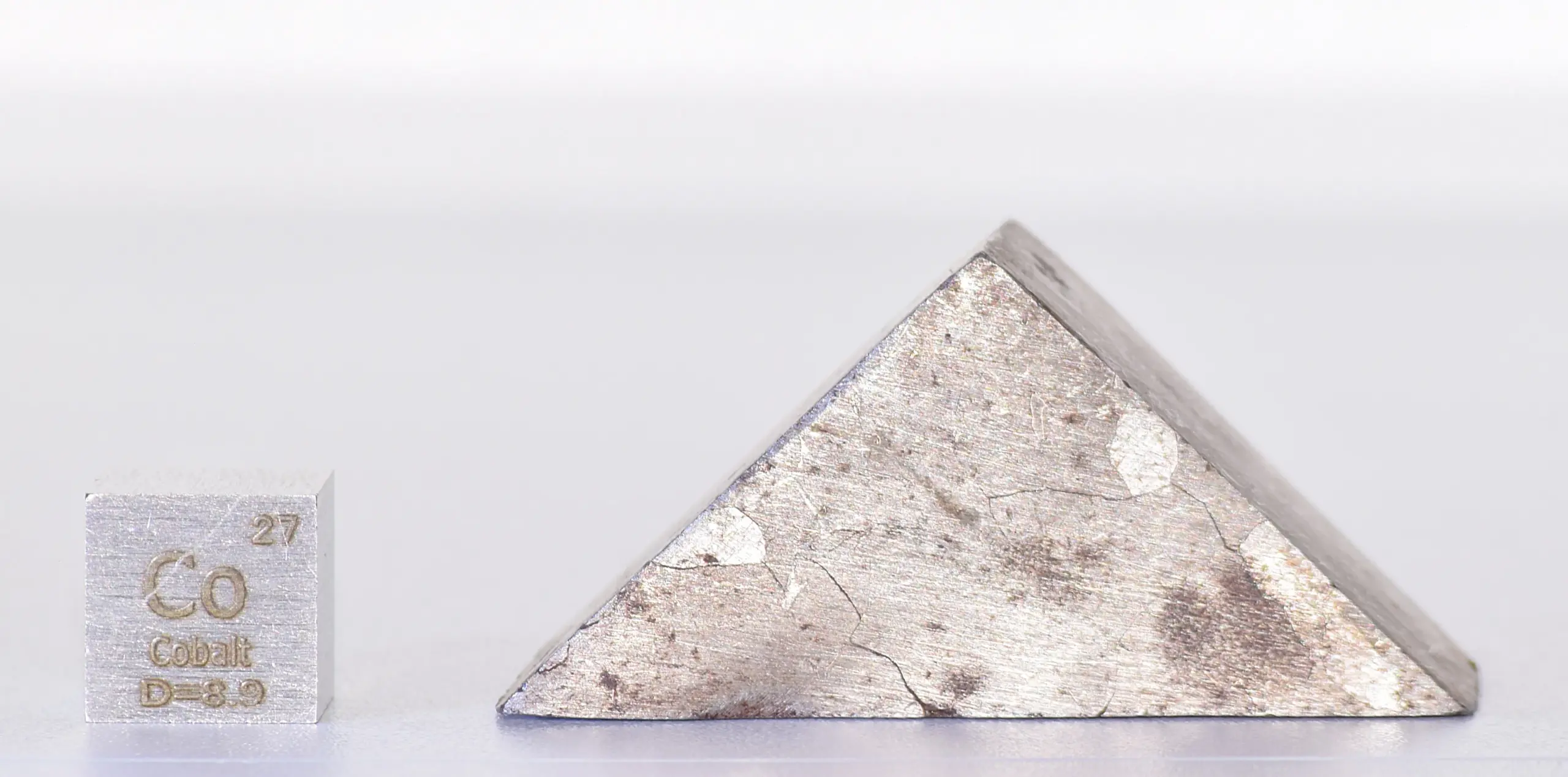
81 g Cut Pyramid of Campo del Cielo Iron Meteorite
Name: Campo del Cielo
Classification: Iron, IAB-MG (Main Group)
Origin: Asteroidal parent body with partial differentiation and complex metal-silicate evolution
Total Known Weight: Several tens of tonnes (large strewn field with numerous recovered masses)
Found: Chaco and Santiago del Estero Provinces, Argentina
Discovery Date: 1576 (first documented Spanish records)
Campo del Cielo: Metal-Silicate Evolution, Asteroidal Differentiation, and IAB Iron Meteorite Formation
1. Formation Context: A Different Path of Asteroidal Evolution
Iron meteorites are generally interpreted as remnants of metal-rich regions formed during the thermal evolution of asteroids. Many groups, such as IVA or IIIAB irons, are considered products of extensive melting and differentiation of their parent bodies. In these cases, molten iron-nickel metal separated from silicate material due to density differences and accumulated in metallic core regions.
Campo del Cielo belongs to the IAB Main Group (IAB-MG) iron meteorites, which represent a different evolutionary pathway. These meteorites preserve a complex association of iron-nickel metal and silicate material, providing evidence for incomplete separation and later interaction between these components during the history of their parent body.
2. Metal-Silicate Formation and Parent Body Evolution
The parent body of Campo del Cielo formed during the earliest stages of Solar System history. Heating by short-lived radioactive isotopes, particularly aluminium-26, contributed to thermal alteration and partial melting of asteroidal material.
During this evolution:
- metallic iron-nickel phases formed through thermal and chemical processes
- silicate material remained associated with metallic regions
- later geological and impact-related processes modified the distribution of metal and silicate phases
The structure of IAB-MG meteorites therefore does not represent the simple crystallization of an isolated asteroid core, but rather a complex sequence of formation and modification processes.
Campo del Cielo iron meteorite — ~4,500,000,000 years old, formed during the early stages of the solar system.
3. IAB-MG Meteorites Compared with Magmatic Iron Meteorites
The scientific importance of Campo del Cielo lies in the difference between IAB-MG meteorites and fully differentiated magmatic iron meteorites.
Magmatic iron meteorites (e.g., IVA or IIIAB):
- originate from metallic melts that separated from silicate material within differentiated asteroids
- represent crystallized metallic core or core-like regions
- preserve a predominantly metal-dominated formation history
IAB-MG iron meteorites (Campo del Cielo):
- contain both iron-nickel metal and silicate inclusions
- preserve evidence of interaction between metallic and silicate reservoirs
- record partial differentiation and subsequent modification processes
Campo del Cielo therefore provides insight into intermediate stages of asteroid evolution that are not preserved in purely metallic core fragments.
4. Mineralogical Characteristics and Chemical Record
Campo del Cielo consists mainly of an iron-nickel metallic matrix containing:
- Kamacite – a low-nickel iron-nickel alloy
- Taenite – a higher-nickel iron-nickel alloy
Associated mineral phases include:
- Troilite (FeS)
- Schreibersite ((Fe,Ni)₃P)
- Cohenite (Fe₃C)
Silicate inclusions contain minerals such as:
- Olivine
- Pyroxene
- Plagioclase
The coexistence of these phases preserves information about the chemical conditions and physical processes that affected the parent body during early Solar System history.
Microscopic View of a 2 g Campo del Cielo Iron Meteorite Fragment
5. Fragmentation Event and Terrestrial Recovery
The Campo del Cielo strewn field is located in northern Argentina, mainly within the provinces of Chaco and Santiago del Estero.
The fragments originated from an extraterrestrial impact event that occurred several thousand years ago and produced a large distribution of iron meteorite masses across the region. The total recovered mass amounts to several tens of tonnes, making Campo del Cielo one of the largest known meteorite finds on Earth.
Among the largest recovered individuals are:
- El Chaco: approximately 28.8 tonnes
- Gancedo: approximately 30.8 tonnes
The meteorite was known by local indigenous populations before European documentation. The first written records of the material date from the 16th century.
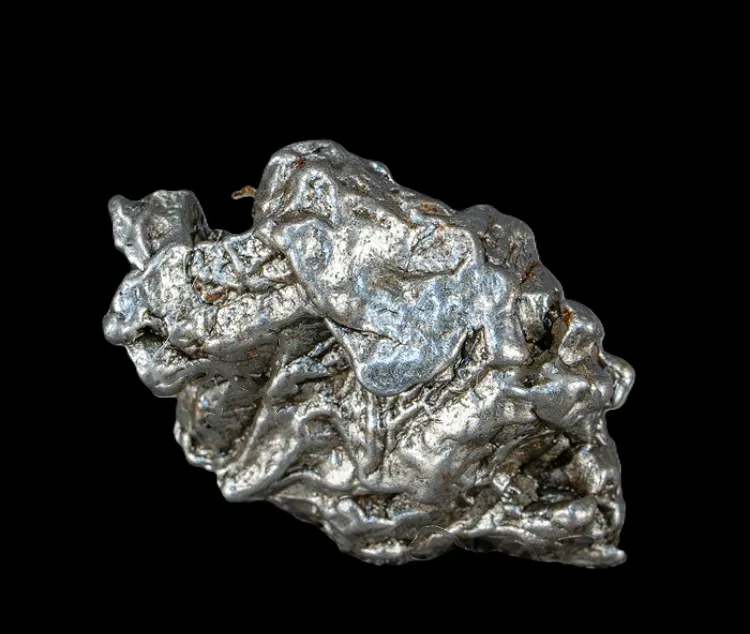
25 g Fragment of the Campo del Cielo IAB-MG Iron Meteorite
6. Scientific Importance
Campo del Cielo is an important example of an IAB-MG iron meteorite because it preserves evidence of complex asteroid evolution.
Unlike iron meteorites that mainly represent crystallized metallic core regions, Campo del Cielo documents:
- metal-silicate interaction within early asteroidal bodies
- partial differentiation processes
- thermal evolution of planetesimals
- later modification through impact and fragmentation events
Due to its exceptional recovered mass and well-preserved mineralogical characteristics, Campo del Cielo remains one of the most important iron meteorites for studying the formation and evolution of early Solar System bodies.
Iron meteorites being recovered from deep within the Earth
References
- Meteoritical Bulletin Database. Entry for Campo del Cielo. The Meteoritical Society.
- Buchwald, V. F. (1975). Handbook of Iron Meteorites. University of California Press.
- Wasson, J. T., Kallemeyn, G. W. (2002). The IAB iron-meteorite complex: A group, five subgroups, numerous grouplets, and two iron masses. Geochimica et Cosmochimica Acta.
- McCoy, T. J. et al. (1996). The origin of silicate inclusions in IAB iron meteorites. Geochimica et Cosmochimica Acta.