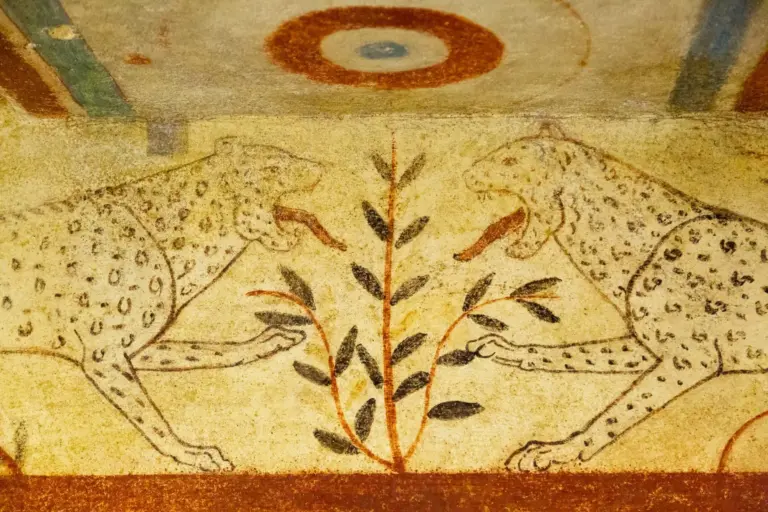
Wall painting from the Tomb of the Leopards in the Monterozzi necropolis at Tarquinia, Italy. The burial chamber is dated to around 470 BCE.
The Iron Age refers to a period in human history characterized by the widespread use of iron as the primary material for tools, weapons, and everyday objects. It follows the Bronze Age and begins in Europe around 800 BCE, continuing into the early historical period.
The Iron Age is marked by profound technological, economic, and social transformations. The spread of iron metallurgy enabled the production of durable and relatively widely available tools and weapons, since iron can be obtained from more common raw materials than bronze. As a result, metal objects became accessible to broader segments of society than before.
The development of ironworking was accompanied by increasing specialization in craftsmanship. Techniques such as hammering, hardening, and controlled heating allowed the production of functionally optimized objects. At the same time, regional traditions emerged in the design of weapons, tools, and ornaments, reflecting archaeologically distinguishable cultural groups.
The Iron Age is characterized by stronger social and political differentiation, leading to the formation of clearly defined hierarchical structures. Social status was no longer based primarily on access to rare metals and long-distance exchange networks, but increasingly on control over local productive resources. With the widespread availability of iron, the concentration of metallurgical resources in the hands of a few diminished, reducing metal itself as a primary source of exclusive prestige. As a consequence, land ownership, agricultural surplus, and the organization of territorial space became more important as foundations of power. In many regions, fortified settlements and regional centers of authority emerged, based on the integration of production and local control. Archaeologically, this development is reflected in richly furnished burials and increasingly differentiated settlement patterns.
In later phases of the Iron Age, larger political entities and increasing urbanization emerged in many regions. In Europe, these developments formed the basis for the transition into the Roman Imperial period and other early state societies.