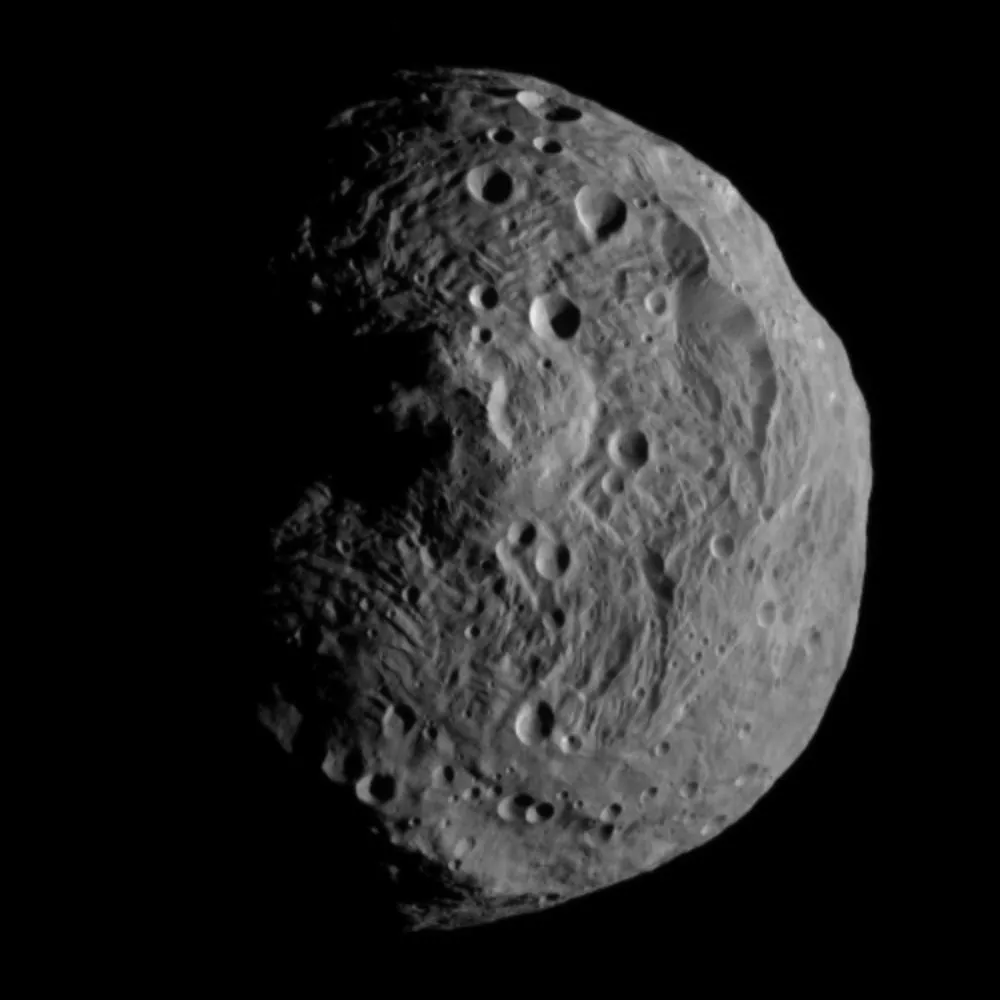
First image of Vesta from orbit at a distance of 16,000 kilometers, July 17, 2011
Differentiated achondrite groups include meteorites derived from asteroids whose interiors were fully or extensively melted, resulting in pronounced chemical and physical separation into distinct reservoirs. In contrast to primitive achondrites, they no longer show transitional features toward chondritic precursor material but consist of rocks formed through intense magmatic processes, crystallization, and internal differentiation. Their mineralogy is typically dominated by pyroxene, plagioclase, and olivine, with variable amounts of metallic iron-nickel occurring in segregated phases. Compared to primitive achondrites, differentiated achondrites therefore record fully developed internal structural and evolutionary systems of asteroidal bodies.
Differentiated achondrite groups are subdivided into several well-defined meteorite classes that differ in mineralogy, texture, chemical composition, and isotopic signatures. The main groups are:
| Group | Characteristic features |
|---|---|
| HED group (Howardite–Eucrite–Diogenite) | Basaltic and plutonic rocks from a differentiated asteroid; likely parent body (4) Vesta |
| Angrite | Highly magmatic, basaltic to gabbroic rocks with unusually high oxidation states and rapid crystallization histories |
| Aubrite | Enstatite-rich, highly reduced achondrites derived from a chemically reduced differentiated parent body |
| Ureilite | Carbon-rich, olivine- and pyroxene-dominated rocks with complex shock and partial melting histories |
Within these groups, individual meteorites record different degrees of magmatic evolution, ranging from early crystallization products to fully developed crustal lithologies. The HED group represents the best-studied system and preserves a coherent crustal section of a differentiated asteroid, including basaltic surface rocks and deeper plutonic lithologies.
The HED group is subdivided into three lithologically and genetically distinct rock types:
Eucrites are basaltic crustal rocks formed by rapid cooling of lava flows or shallow intrusive bodies, typically showing fine-grained to ophitic textures. They represent the upper basaltic crust of the parent body.
Diogenites are coarse-grained, orthopyroxene-dominated plutonic rocks that crystallized slowly at depth, representing deeper crustal or upper mantle regions.
Howardites are polymict breccias consisting of mixtures of eucritic and diogenitic material, formed through repeated impact-driven mixing within the crust of a differentiated body.
The HED group is most commonly associated with asteroid (4) Vesta, which is considered the most likely parent body based on spectral matches and dynamical models, although a direct sample linkage has not been conclusively proven.
Differentiated achondrites formed from asteroids that accumulated sufficient internal heat in the early Solar System, primarily through the decay of short-lived radionuclides such as aluminium-26, to trigger large-scale melting and magmatic differentiation. This led to the separation of metallic and silicate melts and the formation of stable geochemical reservoirs within their parent bodies.
Olivine, pyroxene, and plagioclase are the principal silicate minerals in differentiated achondrites. Olivine and pyroxene dominate in mantle-related and mafic lithologies, whereas plagioclase is abundant in basaltic crustal rocks. Their textures and compositions provide key constraints on crystallization sequences, magmatic evolution, and the internal structure of differentiated asteroids in the early Solar System.
