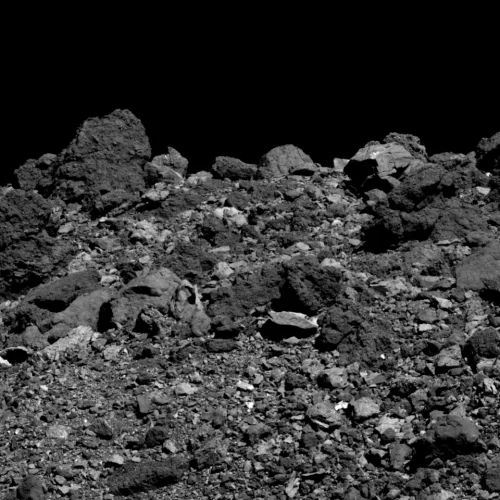
View of Bennu’s equator and northern hemisphere from a distance of 3.6 km, March 28, 2019.
Carbonaceous chondrites are a group of chondritic meteorites characterized by a relatively high abundance of volatile elements such as hydrogen, carbon, nitrogen, and sulfur, as well as organic compounds. They contain only small amounts of metallic iron and are generally more oxidized than ordinary chondrites. Their bulk compositions are often close to solar proportions for non-volatile elements, making them among the most chemically primitive meteorites.
Many carbonaceous chondrites show clear evidence of aqueous alteration, indicating that liquid water was present on their parent asteroids early in the history of the Solar System. This alteration led to the formation of hydrated minerals such as phyllosilicates, carbonates, and magnetite. At the same time, some subgroups preserve highly primitive material that has undergone little thermal processing and therefore represents some of the most unaltered solid matter in the Solar System. In addition, some carbonaceous chondrites contain calcium–aluminium-rich inclusions (CAIs), which are among the oldest solid materials formed in the Solar System.
Carbonaceous chondrites are subdivided into several chemical and petrographic groups, including CI, CM, CO, CV, CR, CK, and CH chondrites. These groups differ in the degree of aqueous alteration, the extent of thermal metamorphism, the oxidation state, the abundance of refractory inclusions, and their bulk chemical composition, reflecting different formation environments and evolutionary histories of their parent bodies.
Carbonaceous chondrites are thought to originate from primitive C-type asteroids in the main asteroid belt, particularly in its outer and middle regions. These asteroids are typically dark, carbon-rich bodies with low albedos, consistent with the composition of carbonaceous chondrites. Several specific asteroids are considered strong candidate sources based on spectral and compositional similarities, including the sample-return targets Bennu and Ryugu, which show direct evidence of hydrated, carbon-rich materials closely related to CI- and CM-type chondrites. These bodies represent fragments of a larger population of early-formed asteroids that have preserved relatively unprocessed material from the early Solar System, although most parent bodies have been disrupted by collisions over time.
