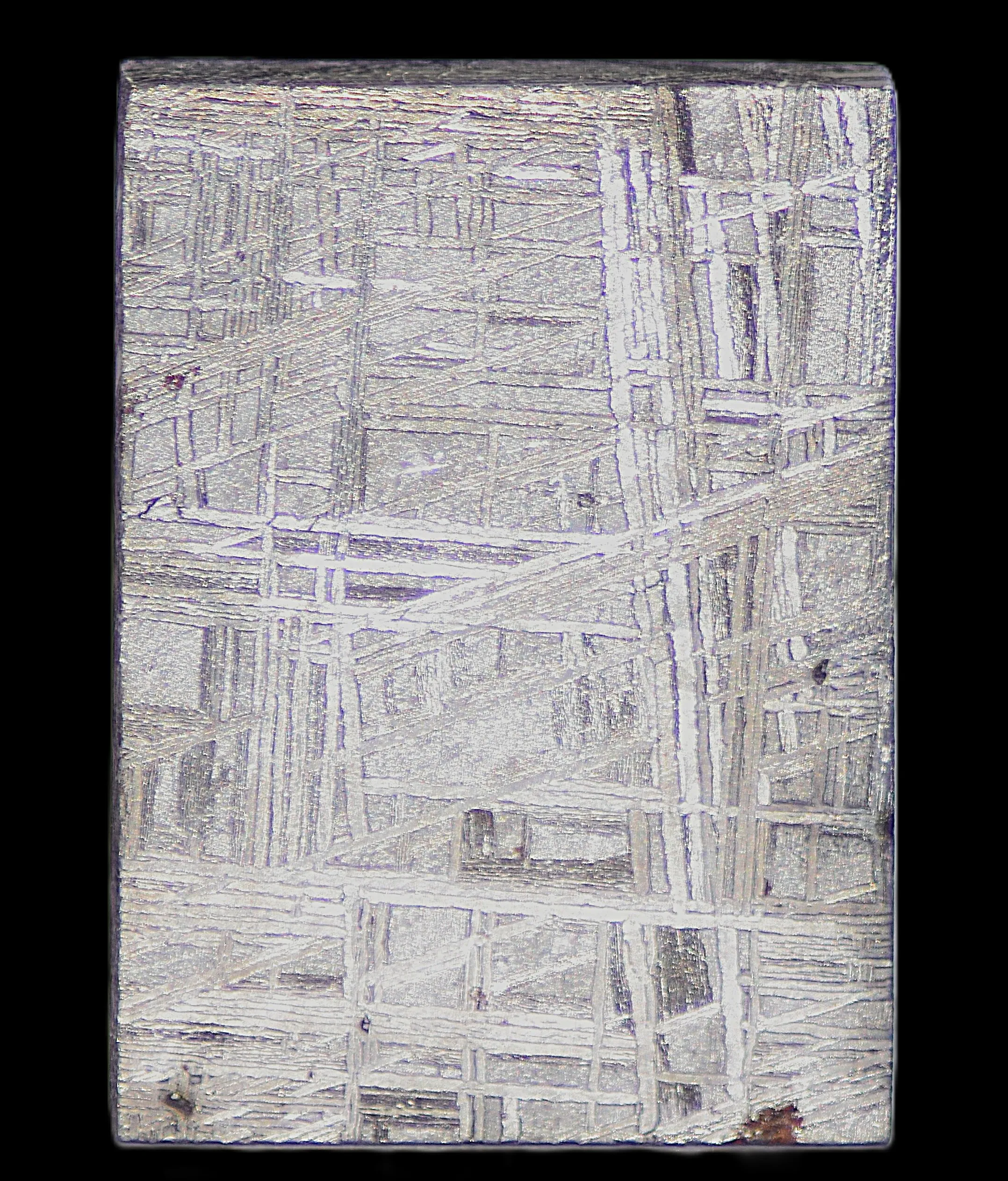
Etched Muonionalusta Iron Meteorite – 80 g Block
• Name: Muonionalusta
• Classification: Iron, IVA
• Origin: Differentiated asteroid (metallic core)
• Total Known Weight: > 230 kg (strewn field fragments totaling thousands of kilograms)
• Found: Norrbotten, Sweden
• Discovery Date: 1906
Muonionalusta: Petrogenetic Framework, Geochemical Systematics, and Shock-Metamorphic History
Abstract / Introduction
The iron meteorite Muonionalusta provides fundamental constraints on the early thermal evolution and collisional history of differentiated planetesimals. Classified as a group IVA iron, Muonionalusta is distinguished by its ancient parent-body age, distinct siderophile element depletion trends, and unique shock-induced mineral assemblages.
Microscopic examination of a cut and etched block of the Muonionalusta iron meteorite.
1. Bulk Chemistry and Siderophile Trace Element Systematics
Muonionalusta is characterized by a bulk composition dominated by iron (Fe) and an average nickel (Ni) concentration of approximately 8.4 wt.%. High-precision trace-element analyses define its membership in the IVA magmatic iron group, yielding typical concentrations of:
Gallium (Ga): ~2.24 ppm
Germanium (Ge): ~0.133 ppm
Iridium (Ir): ~1.6 ppm
In addition to the primary Fe-Ni matrix (comprising kamacite and taenite), the meteorite hosts minor accessory phases and inclusions. These include troilite (FeS), chromitite/chromite (FeCr2O4), daubreelite (FeCr2S4), and schreibersite ((Fe,Ni)3P). Of particular petrological significance is the occurrence of stishovite (SiO2), a high-pressure silica polymorph embedded directly within the metallic matrix.
2. Classification Systematics and Isotopic Age Constraints
The Group IVA designation relies on the strict correlation between metallographic structure and the fractionation trends of siderophile elements (Ni, Ga, Ge).
Crystallization Trends: Group IVA irons exhibit narrow compositional ranges that reflect fractional crystallization processes occurring in the core of a molten asteroidal parent body. The fine octahedral structure (fine octahedrite) develops via the solid-state nucleation and growth of kamacite lamellae out of a homogeneous taenite parent crystal during prolonged cooling.
Geochronology: High-precision lead-lead (Pb-Pb) and rhenium-osmium (Re-Os) isotope systematics constrain the crystallization age of the precursor material to approximately 4.565 x 10^9 years, marking it as a remnant of earliest solar system planetesimal differentiation.

Muonionalusta Iron Meteorite Block – Etched to Reveal the Widmanstätten Pattern – 57 g
3. Petrogenesis: Magmatic Formation and Shock Metamorphic History
Muonionalusta is classified as a magmatic iron meteorite, indicating it formed via planetary differentiation rather than surface impact melting.
The Differentiation Process: During its early evolution, the parent body underwent complete thermal melting. Due to density-driven segregation, the molten iron-nickel alloy sank to the center of the body, while silicate melts formed the outer mantle and crust.
Crystallization Dynamics: Within this metallic core, the melt cooled extremely slowly, facilitating the growth of the fine crystalline lattice.
Shock Metamorphism: Unlike standard magmatic iron meteorites, Muonionalusta contains stishovite—a high-pressure silica polymorph requiring shock pressures exceeding 10 GPa. This mineralogical evidence indicates that the parent body experienced a high-energy collisional event in space approximately 400 million years ago.
4. Terrestrial Dispersion and Weathering History
The fragments were deposited within glacial moraines in northern Sweden during the Quaternary period, surviving multiple glacial cycles over an approximate terrestrial age of one million years. This prolonged exposure to terrestrial environments led to intensive surface weathering, precipitating secondary iron oxides and chlorides, including the rare terrestrial weathering mineral muonionalustaite (Ni3(OH)4Cl2 · 4H2O).

Widmanstätten pattern revealed by acid etching, formed through the extremely slow cooling of iron-nickel metal inside an asteroid.
5. The Widmanstätten Pattern: Visualization through Etching
To reveal the internal crystalline structure, the polished surface is subjected to chemical etching. Because the constituent nickel-iron alloys—kamacit (low-nickel) and taenite (high-nickel)—exhibit differential resistance to acidic solutions, the etchant dissolves the phases at varying rates to produce the Widmanstätten pattern. In Muonionalusta, this geometric network manifests with a fine lamellar spacing of approximately 0.3 mm, directly reflecting the magmatic cooling regime within the parent core.
Buried Beneath Scandinavian Glaciers for Nearly One Million Years
6. References
Meteoritical Bulletin Database. Entry for Muonionalusta. The Meteoritical Society.
Buchwald, V. F. (1975). Handbook of Iron Meteorites. University of California Press.
Holtstam, D., Bindi, L., et al. (2021). Muonionalustaite, a new mineral formed by terrestrial weathering of the Muonionalusta iron (IVA) meteorite. GFF, 143(1), 1–7.
Moskovitz, N. A., & Walker, R. J. (2011). Size of the group IVA iron meteorite core. Earth and Planetary Science Letters, 308(3-4), 410–416.