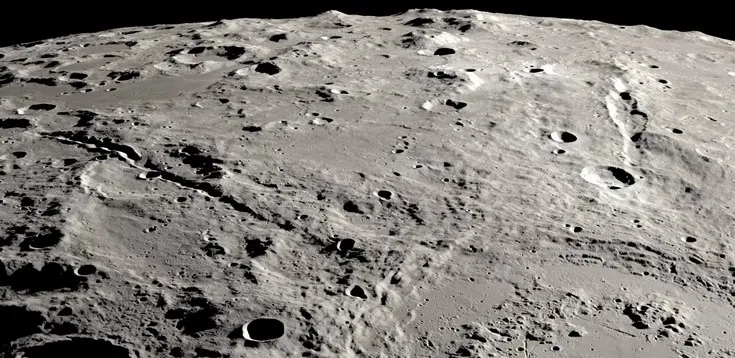
Planetary achondrites comprise meteorites derived from larger differentiated planetary bodies. To date, only two source bodies have been unequivocally identified through geochemical and isotopic analyses: the Moon and Mars. They represent rocks formed under the geological conditions of these bodies and therefore provide insights into volcanism, crust formation, impact processes, and the long-term evolution of planetary surfaces.
| Moon meteorites | |
|---|---|
| Anorthositic lunar meteorites | Plagioclase-rich rocks of the primary lunar highland crust; formed by early lunar magma ocean differentiation and accumulation of feldspar-rich cumulates |
| Basaltic lunar meteorites | Volcanic rocks from lunar mare regions formed by partial melting of the lunar mantle and basaltic lava flows with variable chemical composition |
| Gabbroic lunar meteorites | Slowly crystallized intrusive rocks from deeper crustal levels, coarse-grained plutonic equivalents of mare basalts |
| Lunar breccias | Impact-generated mixed rocks from different lunar lithologies, characterized by strong fragmentation and lithic mixing |
| Regolith breccias | Lithified lunar soil containing fine-grained material, solar-wind implanted components, and local rock detritus |
| Mars meteorites | |
|---|---|
| Shergottites | Basaltic to ultramafic igneous rocks of Mars; largest group, generally relatively young and often strongly shock metamorphosed |
| Nakhlites | Clinopyroxene-rich cumulate or intrusive rocks formed in slowly cooling magmatic systems, in some cases showing aqueous alteration |
| Chassignites | Rare olivine-rich cumulate rocks (dunites) reflecting deeper magmatic differentiation processes on Mars |
| Orthopyroxenite ALH 84001 | Orthopyroxene-rich plutonic rock recording early Martian crustal evolution and later shock overprinting |
| Mars breccias | Impact breccias composed of mixed Martian lithologies formed by large-scale fragmentation and reassembly of crustal material |
Moon meteorites originate from different regions of the lunar surface and were ejected into space by asteroid impacts. Anorthositic meteorites represent the primary lunar highland crust, whereas basaltic and gabbroic meteorites record volcanic and plutonic processes. Lunar breccias and regolith breccias reflect the intense impact history and long-term surface reworking of the Moon.
Mars meteorites originate from the Martian surface or near-surface crust and were ejected by large impact events. Shergottites, Nakhlites, and Chassignites are commonly grouped as SNC meteorites and represent different magmatic environments within the Martian crust. They are complemented by rare Martian breccias and Orthopyroxenite ALH 84001, which provides insight into early Martian evolution.
Plagioclase, pyroxene, and olivine are among the most important minerals in planetary achondrites. Their composition and textures provide key information on magmatic processes, crust formation, volcanism, and planetary evolution.
