
• Name: Aletai
• Classification: Iron, IIIE-an (anomalous)
• Origin: Differentiated asteroid (metallic core)
• Total Known Weight: > 74 tons
• Found: Xinjiang, China
• Discovery Date: 1898
Aletai: Detailed Petrogenetic Analysis and Geochemical Classification
The iron meteorite Aletai represents one of the most significant study objects in modern meteoritics due to its massive scale and complex chemical signature. The following analysis examines the geochemical parameters that identify the meteorite as an “anomalous” member of the IIIE group and defines its magmatic formation history.
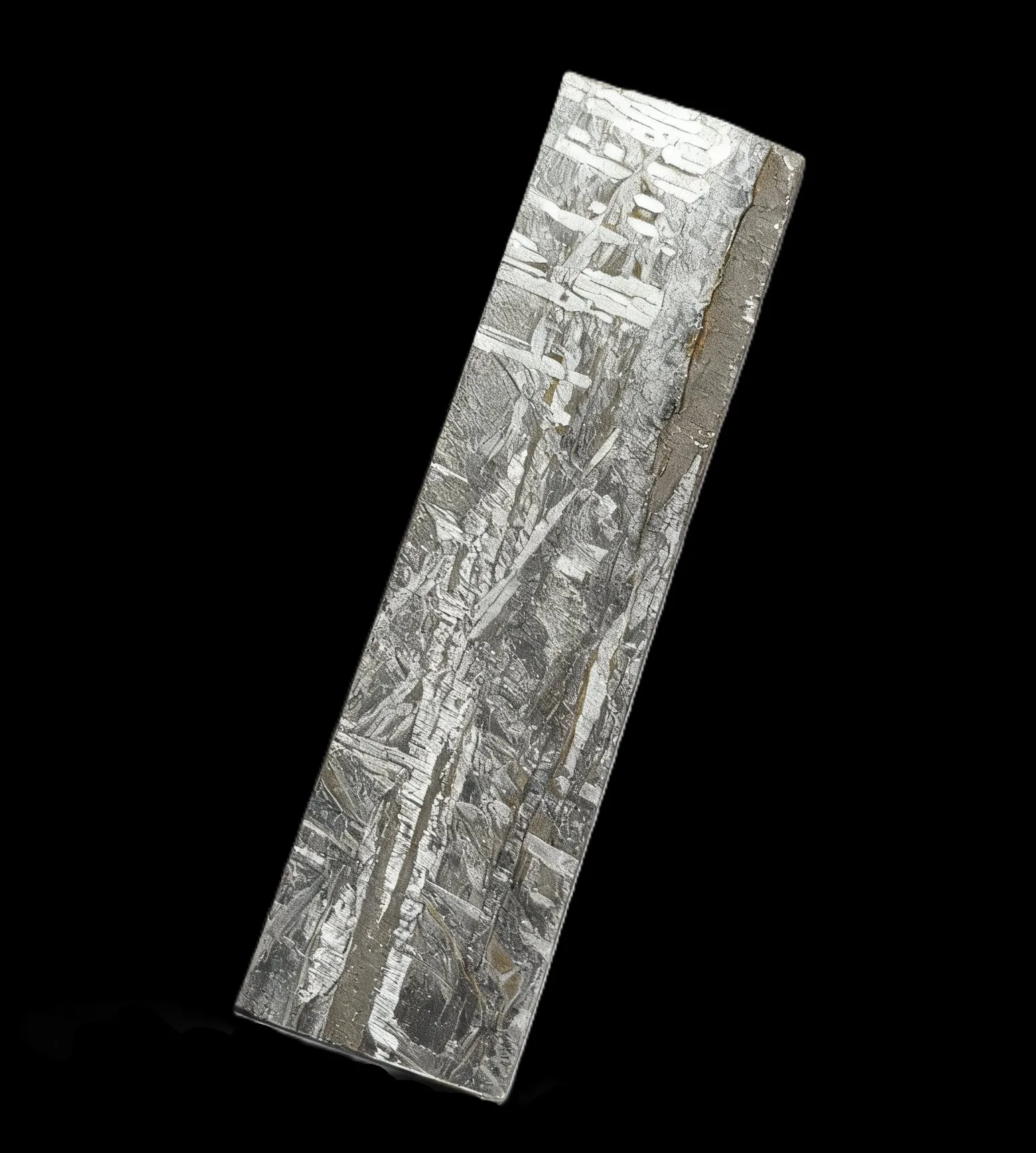
Cuboid specimen of Aletai iron meteorite, 222 g
Chemical Composition
The Aletai iron meteorite is predominantly composed of iron (Fe) at approximately 76.76% and nickel (Ni) at 13.28%. In addition to these primary components, it contains approximately 0.56% cobalt (Co) and trace amounts of other elements, including 109 ppm copper (Cu), 16.9 ppm gallium (Ga), 14.4 ppm arsenic (As), 1.81 ppm gold (Au), and 0.228 ppm iridium (Ir). This unique elemental signature, particularly the elevated gold and iridium concentrations, classifies it as an anomalous member of the IIIE iron meteorite group.
Classification Systematics: The IIIE-an Anomaly
The designation “IIIE-an” (anomalous) is based on the correlation between structural morphology and chemical composition.
Group Affiliation (IIIE): The IIIE group comprises iron meteorites characterized by a coarse octahedral structure. This structure forms through the growth of kamacite lamellae within a taenite host crystal during cooling. Chemically, IIIE meteorites are defined by their ratios of nickel (Ni), gallium (Ga), and germanium (Ge). These siderophile elements serve as a fingerprint for the process of fractional crystallization within a metallic asteroid core.
The Anomaly (-an): The “anomalous” suffix is mandatory because, while Aletai exhibits the structural signature of the IIIE group, it deviates significantly from theoretical trends regarding its gold (Au) and cobalt (Co) concentrations. This discrepancy suggests that Aletai originated from a region of the parent body where fractional crystallization was modified by internal or external variables. Unlike typical IIIE members, Aletai is chemically more heterogeneous, indicating a more complex thermal history within the original asteroid.
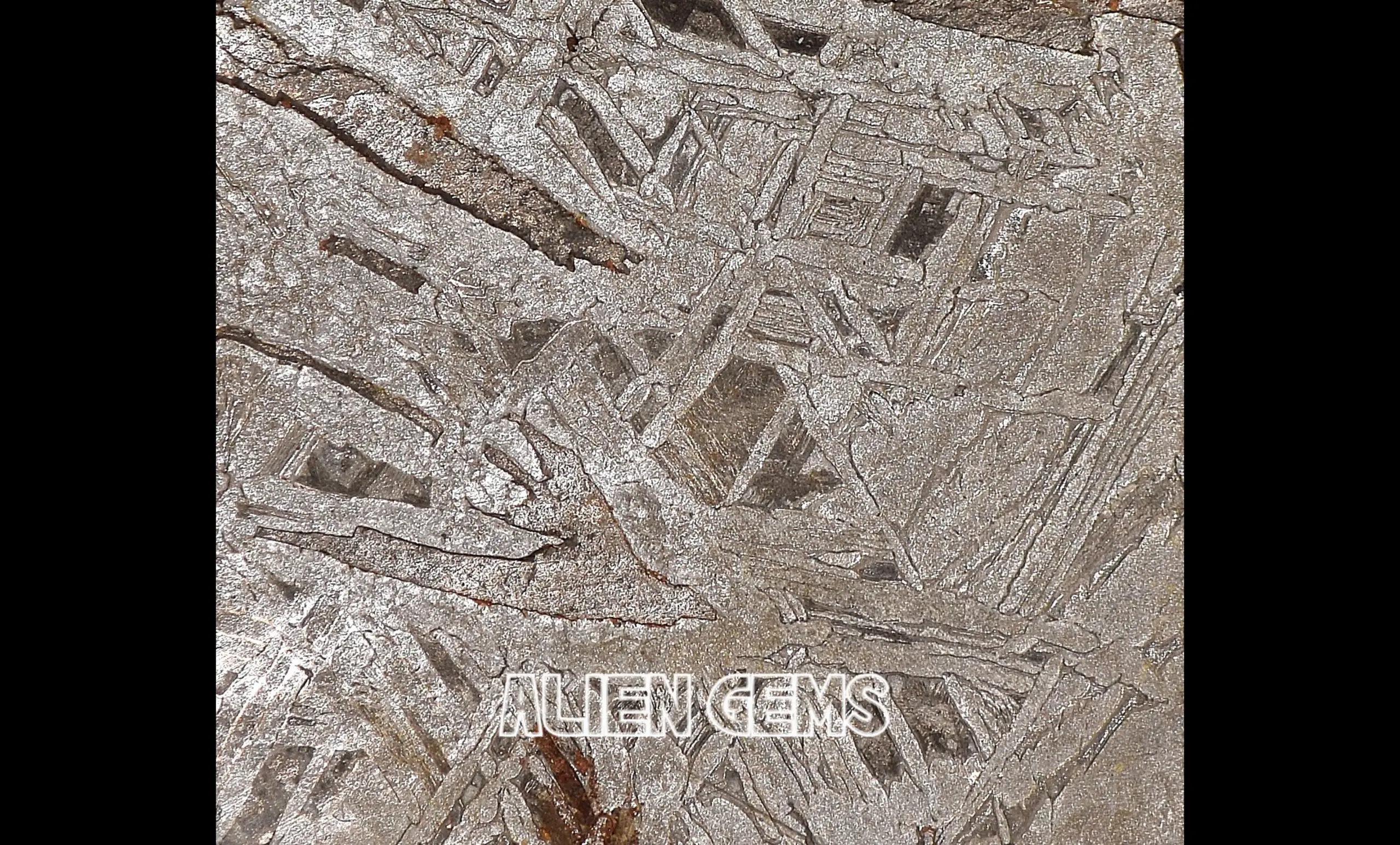
Microscopic examination of an Aletai fragment
Petrogenesis: Magmatic Formation and Differentiation
Aletai is classified as a magmatic iron meteorite. This implies it is not the product of impact melting on an asteroid’s surface, but a direct result of planetary differentiation.
The Differentiation Process: In its early phase, Aletai’s parent body underwent complete thermal melting. Due to density-driven separation, the molten iron-nickel mixture sank to the center of the body, while silicate melts formed the outer layers (mantle/crust).
Crystallization Dynamics: Within this metallic core, the melt cooled extremely slowly, at rates estimated between 10–40 °C per million years. During this cooling phase, components solidified fractionally, forming the specific chemical zoning within the core. Aletai’s “anomalous” chemical signature is therefore a primary feature established during this slow solidification process.
Thermal History: Analysis of the Widmanstätten patterns and kamacite lamellae widths confirms this slow cooling process, excluding a short-lived shock or impact-melt genesis (non-magmatic). Aletai represents material that crystallized deep within the asteroid under high pressure and temperature conditions.

Aletai iron meteorite, 140 g etched slice; acid treatment highlights the internal Widmanstätten crystallization pattern.
Physical Dispersion History
The extraordinary spatial distribution of fragments over a distance of 430 kilometers in Xinjiang correlates with the petrogenetic findings. Physical modeling indicates a shallow entry angle into Earth’s atmosphere. During atmospheric passage, progressive fragmentation occurred along the trajectory, dispersing debris across the entire strewn field. The structural integrity of individual masses, such as the 28-ton Armanty mass, underscores the high mechanical stability of the material, which was established during magmatic crystallization within the parent body.
The Widmanstätten Pattern: Visualization through Etching
To reveal the internal crystalline structure of Aletai, the polished surface is subjected to a chemical etching process. Because the meteorite consists of an intergrowth of two nickel-iron alloys—kamacite and taenite—these phases exhibit different resistance to acidic solutions. By applying an etchant, the phases are dissolved at varying rates, which produces the Widmanstätten pattern. This geometric arrangement of intersecting lamellae is a direct result of the slow, magmatic cooling process within the parent body’s core.
References
Meteoritical Bulletin Database. Entry for Aletai. The Meteoritical Society.
Wasson, J. T., & Wang, J. (1986). A comparative study of iron meteorites of groups IIIE and IIIAB. Geochimica et Cosmochimica Acta, 50(5).
Science Advances (2022). A unique stone skipping-like trajectory of asteroid Aletai. Science Advances, 8(25). DOI: 10.1126/sciadv.abm6063.