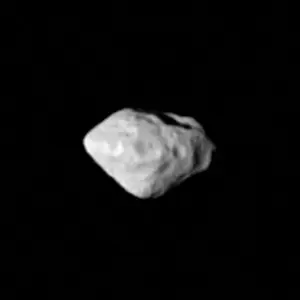
Asteroid (2867) Šteins, captured in September 2008 during the flyby of ESA’s Rosetta spacecraft.
Enstatite chondrites are a rare group of chondritic meteorites that formed under conditions of very low oxygen availability in the early Solar System. As a result, iron could hardly oxidize during their formation and is therefore present mainly in metallic form (Fe, Fe-Ni) or as iron sulfides, while oxidized iron within silicate minerals is only present in minor amounts. Their mineralogy is dominated by enstatite (MgSiO₃), accompanied by sulfides such as troilite and niningerite, as well as metallic iron-nickel.
A characteristic feature of enstatite chondrites is the absence of evidence for aqueous alteration, indicating that their parent bodies remained essentially dry throughout their evolution. Many enstatite chondrites also record varying degrees of thermal metamorphism, reflecting internal heating of their parent asteroids after accretion.
Enstatite chondrites are subdivided into two main groups: EH (high-iron) and EL (low-iron) chondrites. These groups differ primarily in metal content, grain size, and thermal history. Both groups are further classified into petrologic types 3 to 6, which describe the degree of thermal metamorphism from relatively primitive material to strongly recrystallized rock.
Enstatite chondrites are associated with asteroids that formed under strongly oxygen-reduced conditions in the inner region of the asteroid belt. Possible source regions include E-type and related asteroid populations, as well as the inner main belt and the Hungaria region. Although no single parent asteroid has been definitively identified, these bodies are considered the most likely sources based on their spectral properties and mineralogical similarity to enstatite chondrites.
