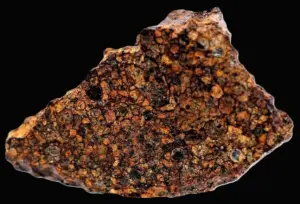
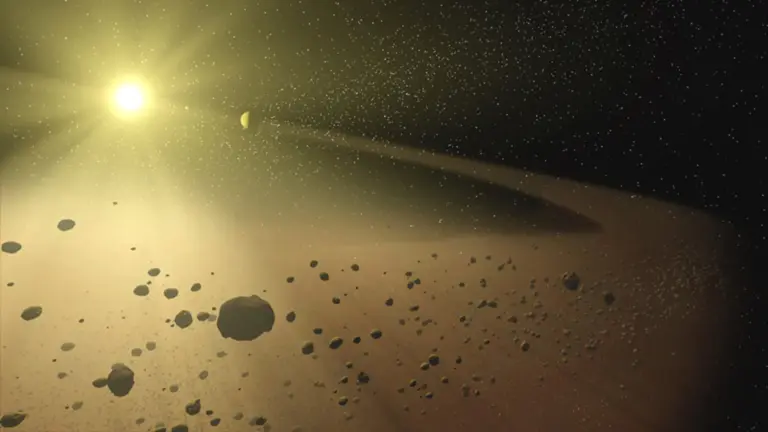
Chondrites originate from asteroids and consist of material that has not undergone complete melting or planetary differentiation, and therefore preserves its original composition from the early phase of the Solar System, before planets and asteroids had fully formed. They typically contain small spherical inclusions called chondrules, which formed from once-molten droplets of rock during this early period. Chondrites are among the most scientifically significant meteorites. Many fundamental insights into the chemical evolution of the early Solar System are based on the study of chondritic meteorites and their mineralogical components.
Chondrites can be divided into several main groups that differ in metal content, redox conditions, and the degree of thermal and aqueous alteration after their formation. These characteristics reflect both the conditions in the early Solar System and subsequent processes within their parent bodies. Four main groups are distinguished:
Ordinary Chondrites
Carbonaceous Chondrites
Enstatite Chondrites
Rumuruti (R) Chondrites