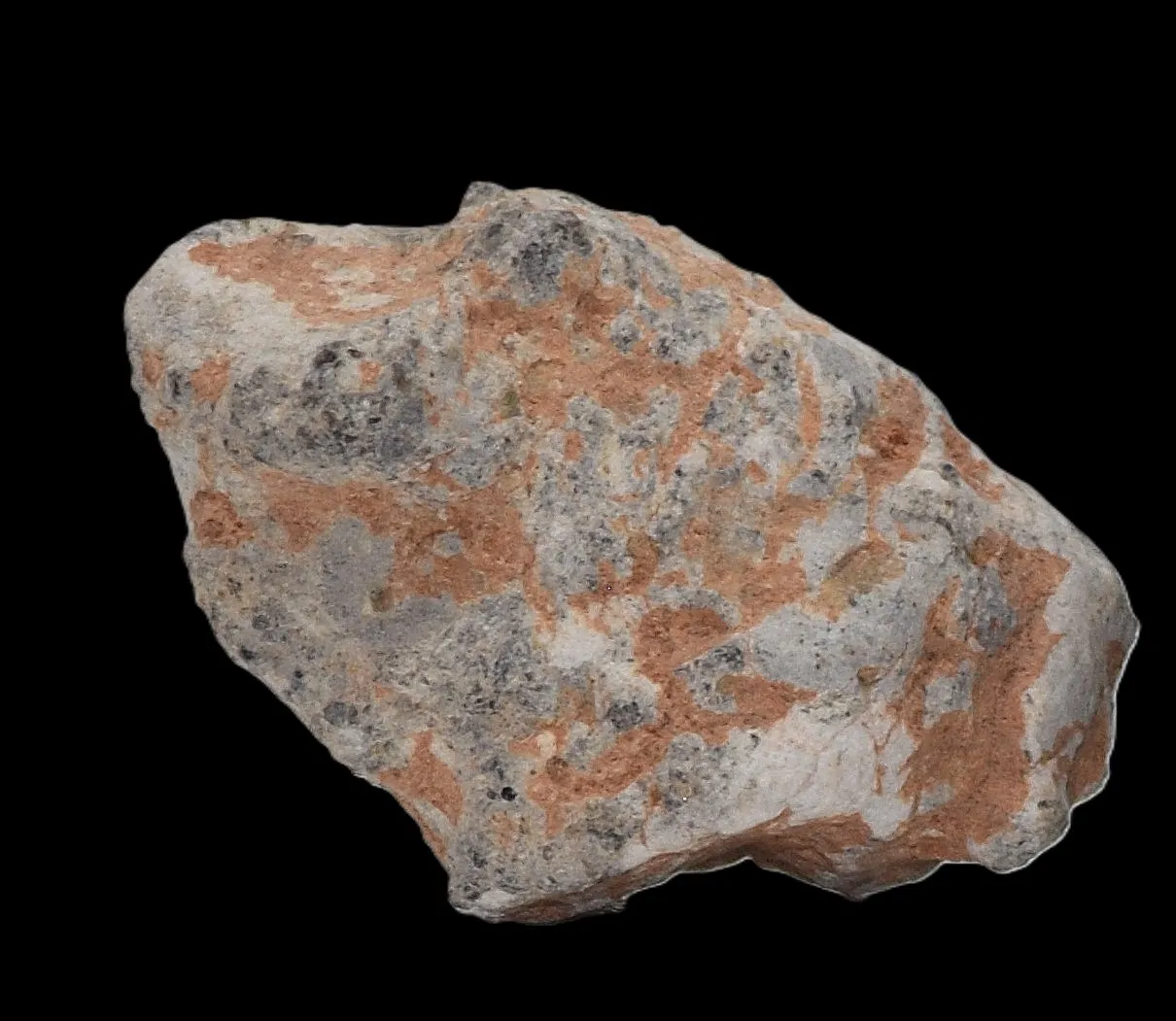
• Name: Béchar 006
• Classification: Lunar (feldspathic breccia)
• Origin: Moon (ejected via a major impact event onto the lunar surface)
• Total Known Weight: >7.21 kg registered officially in the Meteoritical Bulletin (representing the initial documented main mass secured and classified), with additional field recovery material distributed across the strewn field
• Found: Béchar Province, Algeria (30.894°N, 3.395°W)
• Discovery Date: March 2022
Béchar 006: Petrogenetic Framework, Geochemical Systematics, and Impact-Metamorphic History
The lunar meteorite Béchar 006 provides fundamental constraints on the crustal composition, impact gardening, and geological evolution of the lunar highlands. Classified as a lunar feldspathic breccia, Béchar 006 is distinguished by its polymict fragmental assembly, distinct mineral chemistry, and characteristic impact-melt matrix preserved from the lunar surface.
Microscopic examination of a Bechar 006 fragment
1. Bulk Chemistry and Mineralogical Systematics
Béchar 006 is classified as a fine-grained polymict breccia, a complex geological composite formed through repeated impact fracturing, mixing, and consolidation of diverse precursor lithologies from the lunar crust. Rather than originating from a single uniform magma source, the meteorite integrates a multitude of mineral and rock fragments that reflect the highly disrupted nature of the lunar highland regolith.
The primary mineralogy consists of broken mineral fragments and micro-clasts set within a dense, compacted fine-grained matrix. The principal silicate phases defining its modal mineralogy include:
Plagioclase Feldspar: Dominates the anorthositic lithic clasts and mineral fragments. Microprobe analyses reveal an extremely calcic composition, corresponding to An_{96.2±0.8}Or_{0.1±0.1} (anorthite), which is characteristic of the primordial plagioclase cumulates that floated to form the ancient lunar highlands during the crystallization of the lunar magma ocean.
Olivine: Present as distinct mineral fragments within the matrix, exhibiting a fayalite content of Fa_{28.3±6.4}. The characteristic mean iron-to-manganese atomic ratio of approximately 112 provides a critical geochemical fingerprint used by petrologists to distinguish lunar silicates from terrestrial or asteroidal equivalents.
Pyroxenes: Comprise both low-calcium and calcium-rich varieties. Low-Ca pyroxene compositions cluster around Fs_{26.4±4.0}Wo_{4.1±2.1} (orthopyroxene/pigeonite range), with a characteristic mean Fe/Mn atomic ratio of approximately 67. These mafic phases record the crystallization of deeper-seated noritic and gabbroic components of the lunar crust.
Accessory phases and trace minerals intergrown within the silicate matrix and impact-melt domains include:
Ilmenite (FeTiO_3): A common titanium-iron oxide marking local pockets of basaltic or evolved impact-melt material.
Troilite (FeS): Iron sulfide occurring as microscopic grains, reflecting sulfur inventory within the lunar regolith.
Ni-Bearing Metal: Reduced metallic iron-nickel phases indicative of meteoritic contamination from ancient impactors mixed into the regolith (“meteoritic component”).
Micro-Zircon Grains: Extremely rare accessory crystals that serve as critical targets for high-precision radiometric U-Pb geochronology, recording ancient magmatic crystallization events dating back over four billion years.
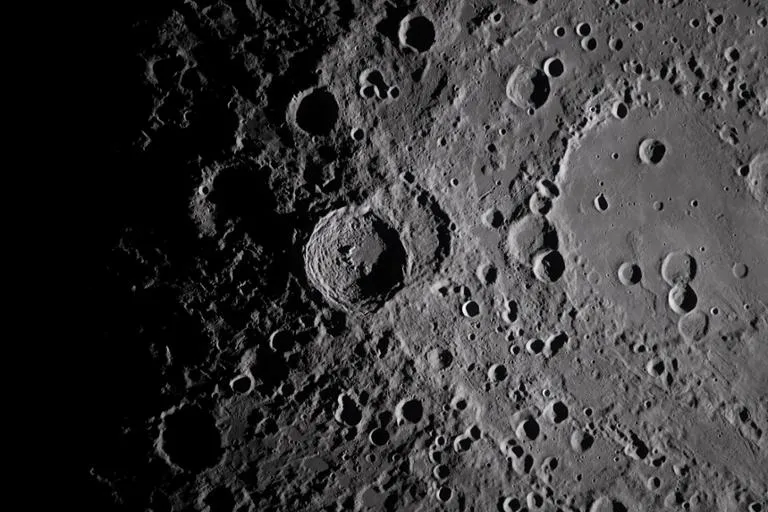
Image captured by the Artemis II crew showing the heavily cratered and uneven surface of the Moon.
2. Classification Systematics and Isotopic Context The Lunar (feldspathic breccia) designation relies on textural integration and mineralogical fingerprinting matching highland samples returned by Apollo.
Lithological Trends: The breccia incorporates subrounded units of clast-rich impact melt rocks, reflecting severe comminution and mixing processes driven by serial hypervelocity bombardment of the lunar crust.
Origin and Transportation to Earth: Béchar 006 represents primitive primordial highland crust formed during the early differentiation of the lunar magma ocean. When a hypervelocity asteroidal or cometary impact struck the lunar surface, a portion of this anorthositic regolith was accelerated beyond the Moon’s escape velocity (~2.4 km/s) and injected into an independent heliocentric orbit. After traveling through space for an extended period, the meteoroid intersected Earth’s orbit, entered the atmosphere, and landed across the desert terrain of northwest Africa.
3. Petrogenesis: Magmatic Crustal Formation and Impact Metamorphism Béchar 006 originated via planetary differentiation of the early Moon, followed by extensive impact comminution.
The Differentiation Process: During the primordial stage of lunar evolution, global melting resulted in the flotation of buoyant plagioclase, which accreted to form the primary anorthositic highlands, while denser mafic minerals sank into the mantle.
Impact Brecciation: Subsequent hypervelocity impacts shattered, melted, and welded these ancient crustal lithologies into consolidated polymict breccias displaying high shock stages.
4. Terrestrial Dispersion and Weathering History Hundreds of individual stones were recovered by meteorite hunters within the Béchar Province of Algeria starting in March 2022. The material occurs in distinct physical varieties based on exposure: surface-gleaned specimens exhibit light brown exteriors, whereas buried samples feature whitish surfaces coated with secondary orange caliche. All stones lack a fusion crust, and the internal matrix displays a low terrestrial weathering grade.
5. References
Meteoritical Bulletin Database. Entry for Béchar 006. The Meteoritical Society.
Metzler, K. Institute for Planetology (IfP), University of Münster. Type specimen and classification write-up, Meteoritical Bulletin No. 111.