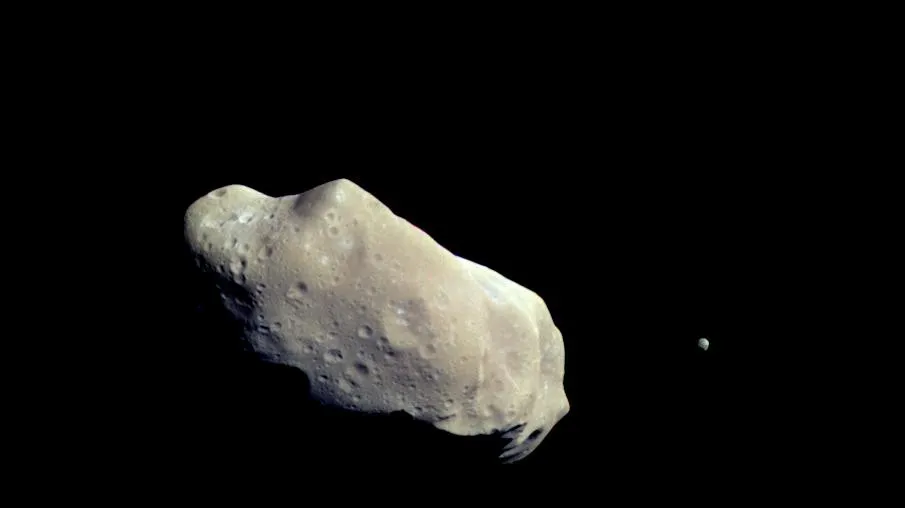
Asteroid (243) Ida (approx. 60 × 25 km) with its moon Dactyl. It orbits, together with thousands of similar-sized bodies, in the asteroid belt between the orbits of Mars and Jupiter.
Ordinary chondrites are the most common group of chondritic meteorites. They contain a relatively high proportion of metallic iron and are among the more oxidized chondrite materials overall. Their mineralogy is dominated by olivine and pyroxene, accompanied by metallic iron-nickel and iron sulfides. A key characteristic of ordinary chondrites is the wide range of thermal metamorphism they record, reflecting varying degrees of heating within their parent bodies after accretion.
Based on the degree of thermal metamorphism and associated textural and mineralogical changes, ordinary chondrites are subdivided into petrologic types 3 to 6. Type 3 represents the least altered material, preserving primitive features such as well-defined chondrules and a fine-grained matrix, whereas types 4 to 6 record progressively stronger thermal metamorphism, leading to recrystallization and increasing homogenization of mineral phases.
In addition to this metamorphic classification, ordinary chondrites are divided into three chemical groups based on iron content: H (high iron), L (low iron), and LL (low iron, low metal). These groups differ in total iron abundance, metal-to-silicate ratio, and oxidation state, reflecting differences in their precursor materials or formation environments. Together, these subdivisions define the internal structure of ordinary chondrites as H-, L-, and LL-groups, each spanning petrologic types 3 to 6.
Ordinary chondrites are thought to originate from S-type asteroids located primarily in the inner to middle main asteroid belt. These asteroids are generally associated with silicate-rich, moderately oxidized material similar in composition to ordinary chondrites. While no single asteroid has been unambiguously identified as the source of ordinary chondrites, several asteroid families are considered potential parent-body candidates based on spectral similarities and dynamical considerations, including families in the inner main belt such as the Flora and related groups. Ordinary chondrites are therefore interpreted as fragments of a larger population of early-formed asteroidal bodies that have undergone varying degrees of thermal metamorphism and fragmentation over Solar System history.
Olivine and pyroxene are the two principal silicate minerals in ordinary chondrites. Olivine is a magnesium-iron silicate with the general formula (Mg,Fe)₂SiO₄, typically forming relatively homogeneous crystals that are sensitive to thermal metamorphism. Pyroxenes are magnesium-iron silicates with the general formula (Mg,Fe)SiO₃ and occur in several structural varieties with variable internal chemical zoning. Both minerals originally crystallized from dust and gas in the early Solar System and constitute the dominant silicate fraction of these meteorites.
