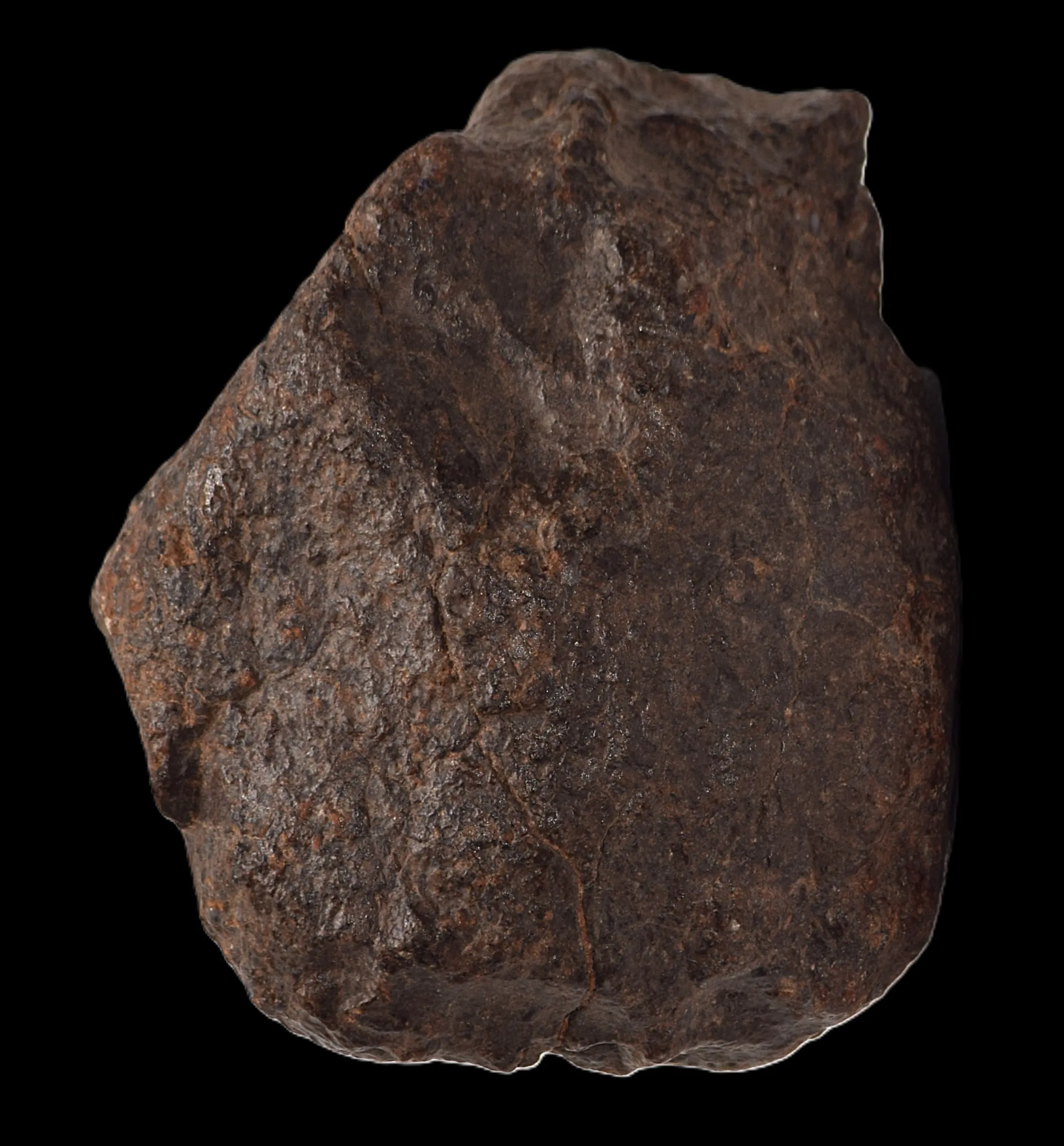
95 g specimen of Tisserlitine 007
• Name: Tisserlitine 007
• Classification: HED achondrite — Eucrite melt breccia
• Origin: Differentiated HED parent body, likely asteroid 4 Vesta
• Total Known Weight: ~30 kg
• Found: Mali, Gao Region
• Discovery Date: 2025
Tisserlitine 007 is an officially classified HED achondrite discovered in Mali in February 2025. With a registered total known weight of approximately 30 kg, it is classified as a eucrite melt breccia. Its structure consists of fragments of eucritic material embedded in a solidified melt matrix, providing evidence of impact-related processes on its parent body.
Mineralogy
The mineral assemblage of Tisserlitine 007 is dominated by pyroxene and calcium-rich plagioclase. The official classification data identify two distinct pyroxene compositions.
The low-calcium pyroxene has an average composition of Fs 61.1 ± 1.0 and Wo 2.4 ± 0.8, with a measured Fe/Mn atomic ratio of 34.3. The calcium-rich pyroxene occurring in exsolution lamellae has an average composition of Fs 27.8 ± 1.5 and Wo 41.9 ± 1.9.
Plagioclase has an average composition of An 88.4 ± 3.9 and Or 0.5 ± 0.4, indicating a calcium-rich, anorthitic feldspar.
Accessory minerals and phases include a silica polymorph, ilmenite, chromium spinel and troilite.
Petrography
Tisserlitine 007 is described as a clast-rich melt rock. It contains subrounded eucritic lithic clasts measuring up to approximately 7 mm across, displaying both basaltic and gabbroic textures. Mineral fragments, predominantly pyroxene and plagioclase, are embedded in a crystallized melt matrix.
Many pyroxene grains exhibit shock-deformed exsolution lamellae, indicating that the material experienced substantial impact-related deformation and heating. The meteorite is assigned a high shock stage and a low weathering grade.
Its clast-rich texture and crystallized melt matrix distinguish it from unbrecciated eucrites and provide evidence of impact melting and subsequent solidification.
Origin and Parent Body
Tisserlitine 007 belongs to the HED meteorite group, comprising howardites, eucrites and diogenites. This group is generally associated with asteroid 4 Vesta, one of the largest objects in the asteroid belt.
Vesta underwent extensive internal differentiation early in its history, developing a metallic core, a silicate mantle and a basaltic crust. Eucrites are generally interpreted as fragments of this basaltic crust, making them particularly valuable for studying the geological evolution of differentiated asteroids.
The brecciated structure of Tisserlitine 007 indicates that its parent material was fractured and at least partially melted during impact events. Fragments of pre-existing eucritic rocks and minerals became incorporated into the melt, which subsequently cooled and crystallized.
The association with Vesta is based on the established mineralogical, chemical and isotopic relationship between HED meteorites and this asteroid. However, the specific impact event that produced Tisserlitine 007, as well as the timing of its ejection into space, has not been established.
Find History and Classification
According to the information recorded in the Meteoritical Bulletin Database, Tisserlitine 007 was reportedly found by Naama Sidibuia and his group in February 2025. The find location is an area called Tayat Attafla, near Tazouikert in the Gao Region of Mali.
The official coordinates are 21.6654336° N, 0.8075866° W. The registered total known weight is approximately 30,000 g, consisting of several pieces. No witnessed fall has been reported.
The meteorite was examined and classified by Knut Metzler of the Institute of Planetology (IfP), University of Münster, Germany. A 20 g type specimen is held at the institute, while Naama Sidibuia is listed as the holder of the main mass.
The classification was officially approved on 1 June 2025 and subsequently published in The Meteoritical Bulletin, No. 114.