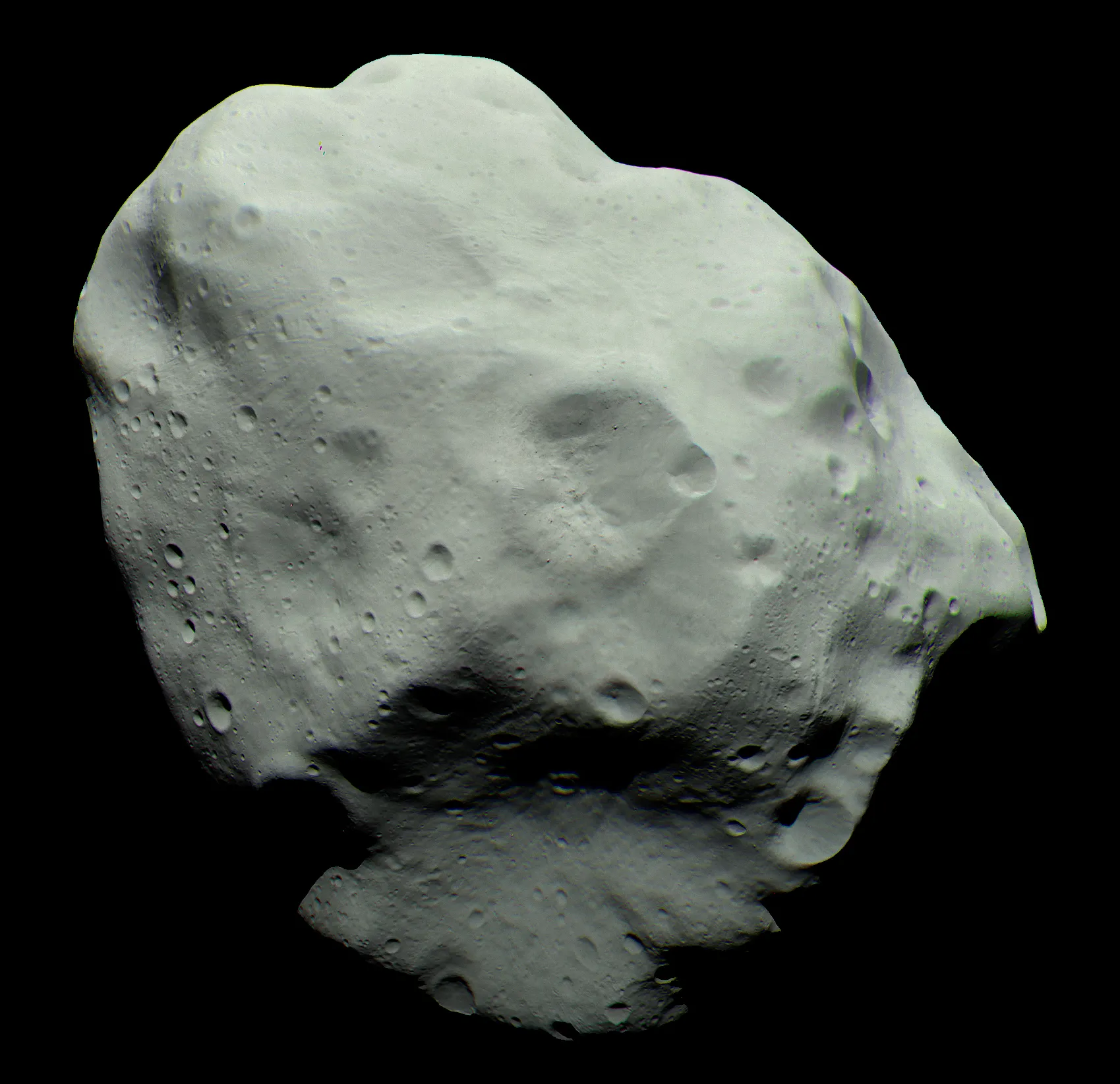
Image of (21) Lutetia taken by the Rosetta spacecraft on July 10, 2010
Stony-iron meteorites originate from asteroids that experienced partial heating in their early history, leading to only incomplete melting so that metal and rocky material did not fully separate. Instead of forming a clear division into core and mantle, iron-nickel metal and silicate rock remained together within the interior, where they locally mixed or solidified in close association. These structures could form through partial melting processes or impact events that re-melted and mixed the material. After cooling, these mixed textures were preserved, and later collisions broke apart the parent bodies, releasing fragments containing both metallic and rocky components that can reach Earth as stony-iron meteorites.
Stony-iron meteorites can be broadly subdivided into two main genetic groups based on their formation processes within differentiated parent bodies. The division is primarily based on differences in texture, mineralogy, and the degree of mixing between metallic and silicate material, which reflect distinct formation environments and impact-related processes. The classification is as follows:
In addition to these two main groups, there exists a small number of rare stony-iron meteorites that cannot be confidently assigned to either category. These ungrouped specimens exhibit unusual or transitional combinations of metal and silicate material, or they lack sufficient compositional and petrographic data for a secure classification. In some cases, their textures or chemical signatures suggest complex or atypical formation histories that do not fit the standard pallasite or mesosiderite formation models.
