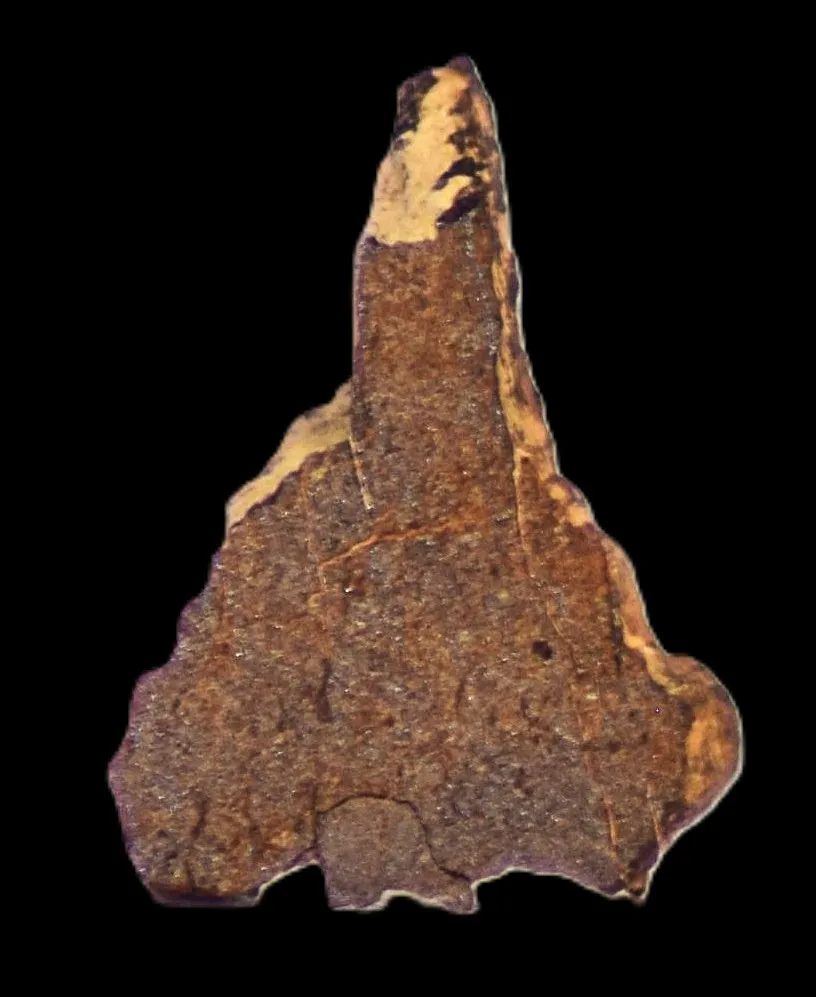
A small 2 g fragment of the distinctively pale, impact-melt breccia Al Haggounia 001.
• Name: Al Haggounia 001
• Classification: EL melt rock (derivate of an EL enstatite chondrite)
• Origin: EL-chondrite parent body (inner solar system)
• Total Known Weight: ~3 t
• Found: Al Haggounia, Western Sahara
• Discovery Date: 2006
With a total recovered mass exceeding three tons to date, Al Haggounia 001 is the largest known representative of the enstatite meteorites. The meteorite was discovered in 2006 in the Western Sahara and was initially classified as an aubrite due to its bright, enstatite-rich composition.
Detailed petrographic and mineralogical investigations ultimately led to a fundamental reassessment of its formation history. Following the revision of the Meteoritical Bulletin in 2019, Al Haggounia 001 has been reclassified as an EL melt rock. This term refers to a shock-generated melt rock whose chemical signature corresponds to the EL group of enstatite chondrites. The abbreviation EL stands for Enstatite Chondrite, Low Iron, denoting enstatite chondrites with a low abundance of metallic iron. This classification does not describe a primary chondritic state of preservation, but rather the genetic origin of the material from an original EL enstatite chondrite that was completely reworked through impact-induced partial to extensive melting.
Al Haggounia 001 is linked to the inner solar system because its EL enstatite chondrite precursor shares unique isotopic signatures with Earth and the Moon. Its highly reduced mineral chemistry further indicates it formed in the hot, volatile-poor region of the early protoplanetary disk near the proto-Sun.
Mineralogy
The mineralogy of Al Haggounia 001 is dominated by nearly iron-free enstatite (MgSiO₃), whose chemical composition is characteristic of the EL group of enstatite chondrites. In addition to enstatite, the meteorite contains sodic plagioclase, silica, and various metal and sulfide phases. Characteristic mineral phases include silicon-bearing kamacite, troilite, daubréelite, alabandite, oldhamite, djerfisherite, schreibersite, and graphite.
The mineral assemblage records the highly reducing conditions under which the precursor material formed. In particular, the occurrence of silicon-bearing iron–nickel metal as well as the calcium and manganese sulfides oldhamite and alabandite indicates extremely low oxygen fugacities, which are typical of enstatite chondrites. This characteristic association of reduced metal and sulfide phases provides important information about the chemical conditions under which the original EL-chondritic material formed.
Petrography
Petrographically, Al Haggounia 001 exhibits a complex texture that has been extensively modified by impact-related processes. The material contains recrystallized regions, partially preserved chondrule relics, melt zones, and numerous cavities and vesicular structures.
The original chondritic texture was strongly altered by an impact event. During shock melting, the material underwent partial melting, resulting in the destruction of parts of the original chondrule structure, followed by recrystallization of the silicate phases. At the same time, metal and sulfide phases were mobilized during the melting process and locally redistributed.
The preserved chondrule relics demonstrate that the precursor material was originally an EL chondrite. However, the extensive modification of the texture by melting and recrystallization prevents its classification as a conventional EL chondrite.
Shock Metamorphism and Formation
The current interpretation of Al Haggounia 001 involves a multi-stage formation history. The precursor material was an EL enstatite chondrite that experienced a major impact event on its parent body.
The high pressures and temperatures generated during this event caused partial melting of the rock. The resulting melt subsequently cooled and crystallized, producing a recrystallized impact melt rock. During this process, the original chondritic textures were partly destroyed, while the chemical and mineralogical characteristics of the original EL material were largely preserved.
The presence of recrystallized silicate textures, preserved chondrule relics, impact-related melt structures, vesicular regions, and redistributed metal and sulfide phases provides strong evidence for an impact-melt origin. These characteristics are inconsistent with formation through magmatic differentiation, as observed in aubrites.
Al Haggounia 001 exhibits extensive terrestrial weathering due to its long residence time on Earth. Most investigated samples are classified as W4–W5 on the terrestrial weathering scale. Radiocarbon measurements indicate a terrestrial age of approximately 23,000 ± 2,000 years.
During its prolonged exposure in the desert environment, primary metal and sulfide phases underwent partial oxidation and alteration. These processes resulted in the formation of various secondary minerals, including calcite, gypsum, halite, sylvite, jarosite, melanterite, clay minerals, and iron oxides and hydroxides. Terrestrial weathering particularly affected the preservation of metallic phases and produced local variations between individual fragments.
Scientific Significance
Al Haggounia 001 is of particular importance to meteoritics because it represents one of the largest known impact melt rocks with an EL-chondritic composition. It provides an opportunity to investigate the effects of major impact events on reduced asteroids and offers insights into the alteration processes experienced by primitive bodies in the early Solar System.
The combination of EL-type mineralogy, a complex shock history, a large strewn field, and extensive terrestrial weathering makes Al Haggounia 001 an important reference object for the study of enstatite meteorites.
References
• Rubin, A. E. (2016). Impact melting of the largest known enstatite meteorite: Al Haggounia 001, a fossil EL chondrite. Meteoritics & Planetary Science.
• Leili, M. H., Chennaoui Aoudjehane, H., Devouard, B., Rochette, P., Gattacceca, J., Folco, L., Gemelli, M., & Baziotis, I. (2024). Strewn field, mineralogy, and petrology of Al Haggounia 001: A unique enstatite chondrite. Meteoritics & Planetary Science, 59(2). DOI: 10.1111/maps.14119.
• Meteoritical Bulletin Database. Offizielle Klassifikation und Nomenklatur von Al Haggounia 001.