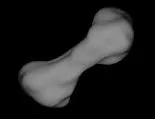
Radar astronomical image of 216 Kleopatra
Non-magmatic iron meteorites differ from magmatic types in that their metallic material did not originate from a fully molten, long-lived metallic core that crystallized under stable conditions. Instead, they form through more complex and often localized processes such as partial melting, impact-generated melting, or the mixing of already differentiated and undifferentiated materials within their parent bodies. In many cases, no stable, fully developed metallic core was formed, which is why the systematic chemical fractionation typical of magmatic iron meteorites is absent. As a result, non-magmatic iron meteorites display much more heterogeneous chemical signatures, reflecting diverse formation pathways and strongly variable physical conditions. The classification of non-magmatic iron meteorites is as follows:
| Group | Description |
|---|---|
| IAB complex | Formed in large impact-melt systems within asteroids; consist of metallic melts mixed with silicate material and inclusions, showing a complex and incompletely differentiated evolution |
| IC | Chemically variable iron meteorites derived from complex mixing and partial fractionation processes within partially molten systems, without evidence for a well-developed metallic core |
| IIE | Iron meteorites with significant silicate components, likely formed through impact processes where metal and silicate melts interacted |
| IIF | Rare group with unusual and difficult-to-classify chemical signatures, indicating a complex and possibly multi-stage formation history |
| IIG | Highly unusual, strongly reduced iron meteorites formed under exceptionally reducing conditions, with distinctive chemical compositions |
| IIC | Small, distinct group with well-defined chemical characteristics but no clear link to classical magmatic core formation processes |
| Ungrouped irons | Iron meteorites that cannot be assigned to any established chemical group, typically due to unique or highly complex chemical and isotopic signatures |