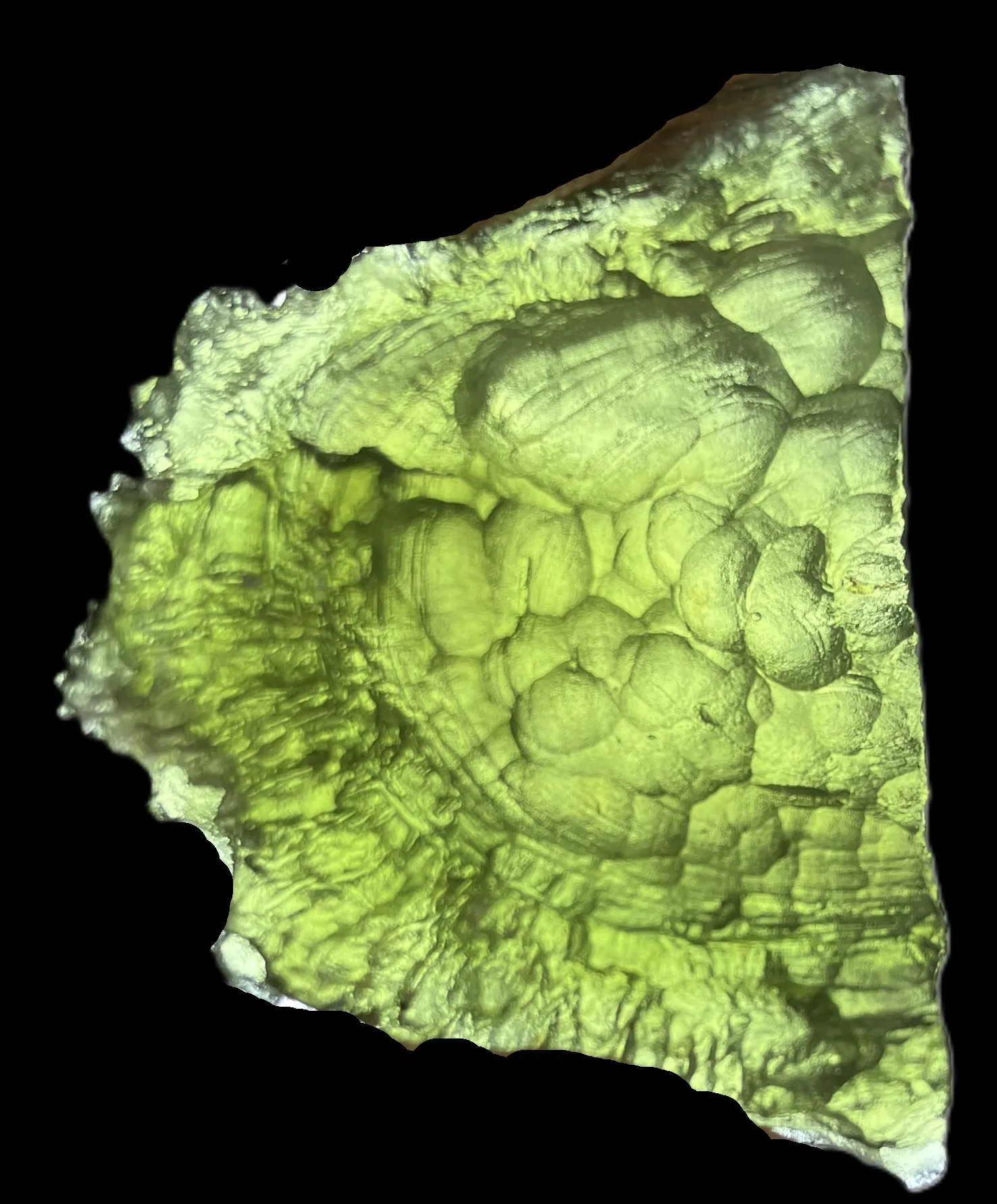
Moldavite specimen showing its characteristic natural texture and sculpted surface. Specimen, weight: 10 g.
Name: Moldavite
Classification: Impactite / Tektite (Natural Glass)
Origin: Terrestrial material fused by an impact event (Ries Crater)
Total Known Weight: Variable (strewn field approx. 60 km wide)
Found: Central Europe (primarily Czech Republic, Moldau River region)
Formation Age: ~14.7 million years (Miocene)
Moldavite is a globally unique, green tektite glass created by a massive meteorite impact event approximately 14.7 million years ago. Unlike extraterrestrial meteoritic material, moldavite is a terrestrial impact glass. It formed when surface material was instantly melted by the immense kinetic energy of the Nördlinger Ries impact (an event caused by a bolide roughly 1 km in diameter) and ejected into the atmosphere, where it cooled and solidified during its ballistic flight.
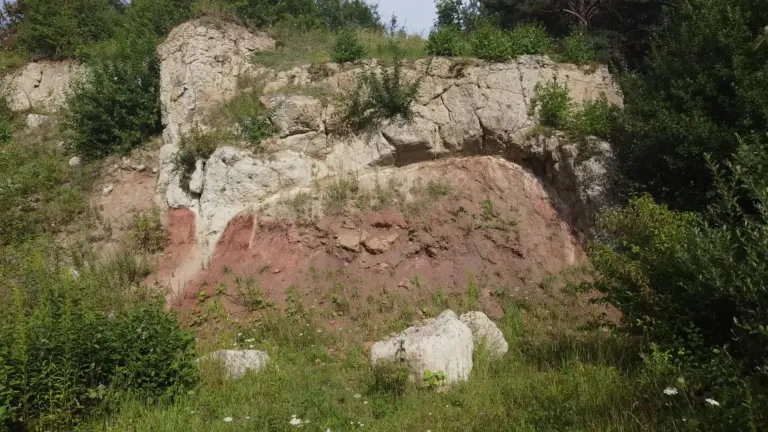
Aumühle Quarry: Ground zero for the cosmic impact that created and launched Moldavite tektites 15 million years ago.
Geochemical Composition and Structure
The composition of moldavite acts as a direct geological dataset of the local terrain at the time of the impact. It is characterized by the following features:
Chemical Signature: The chemical composition (predominantly siliceous with a high SiO2 content) correlates precisely with the sediments found in the Ries Crater (primarily upper Jurassic sands and marls). A diagnostic marker is its extremely low water content (mostly below 0.02 wt.%), which is attributed to the extreme temperatures during formation and rapid outgassing in the atmosphere.
Physical Phase (Amorphous): Unlike meteoritic pallasites, which exhibit crystalline structures (olivine/metal), moldavite is completely amorphous and lacks a crystal lattice. The characteristic surface texturing (“sculpting”) of moldavites is not a primary formation feature, but rather the result of secondary terrestrial etching by humic-acid-bearing groundwaters following deposition.
Inclusions (Lechatelierite): A microscopic characteristic is the presence of lechatelierite inclusions—pure silica glass threads formed at temperatures exceeding 1700 degrees Celsius. These inclusions prove the extreme thermal stress during the impact and serve as a “geological thermometer.”

Small 3 g Moldavite fragment, illuminated to reveal its natural internal structures.
Genesis and Formation History
The formation of moldavite can be divided into a complex thermodynamic sequence:
Shock Metamorphism: During the impact of the bolide in the Ries region, the target substrate was instantaneously converted into a liquid state under extreme shock pressure.
Ballistic Transport: The molten melt was propelled into the upper atmosphere by the pressure wave. This “tektite cloud” traveled distances of several hundred kilometers before landing in the area of the present-day Moldau River basin.
Quenching: The solidified shapes of the glass (drops, discs, or dumbbells) resulted from aerodynamic stabilization during flight through the atmosphere. The cooling rate was far too rapid to allow crystallization.
Small Moldavite fragment in natural light
Reconstruction of the Impact Event
Moldavite serves the scientific community as a precise instrument for reconstructing the Ries event:
Geochemical Remote Action: By analyzing the distribution of the strewn field, geologists have been able to accurately calculate the trajectory and energy of the impact. Moldavite proves that material was blasted as high as the stratosphere during the event.
Thermodynamic Indicators: The shape of gas bubbles trapped inside moldavites under vacuum or low-pressure conditions provides insight into the atmospheric parameters during formation.
Terrestrial Alteration
In contrast to meteoritic finds that weather via oxidation, moldavite is geochemically highly stable and virtually resistant to oxidation. The only significant modification is the chemical corrosion of its surface by groundwater. However, this surface alteration is purely exogenous and does not affect the chemical integrity of the internal glass matrix, making moldavite an exceptional archive for studying the conditions of the early terrestrial environment.
References
Delano, J. W. (1986). Igneous phosphate minerals as indicators of the origin of tektites. Geochimica et Cosmochimica Acta, 50(5), 995–1003.
Stöffler, D., & Grieve, R. A. F. (2007). Impactites. In H. R. Wenk (Ed.), Systematics and History of Planetary Nomenclature / Recommendations of the IUGS Subcommission on the Systematics of Metamorphic Rocks.
Koeberl, C. (1994). Tektites, impact ejecta, and the age of impacts. Geological Society of America Special Papers, 293, 133–151.