
5.6 g fragment of NWA 16018, an HED howardite-melt breccia
- Name: Northwest Africa 16018 (NWA 16018)
- Classification: Achondrite — HED, Howardite-melt breccia
- Petrological character: Polymictic impact-melt breccia
- Parent body: HED parent body, generally associated with asteroid 4 Vesta
- Total Known Weight: 1.15 kg
- Found: Northwest Africa
- Place of purchase: Algeria
- Year found: 2023
- Official classification: Meteoritical Bulletin No. 112
- Shock stage: High
- Weathering grade: W2
Northwest Africa 16018 (NWA 16018) is an HED achondrite classified as a Howardite-melt breccia. The total known weight is 1.15 kg, distributed among seven dark grayish fragments. The material was purchased from a meteorite dealer in Algeria in 2023. The specimens lack fusion crust.
NWA 16018 is particularly interesting because it combines the characteristic polymictic nature of a howardite with a substantial impact-melt component. The meteorite consists of rock and basaltic clasts together with numerous individual mineral fragments embedded in a finely recrystallized melt-rock matrix. This combination records both the pre-existing lithological diversity of the HED parent body and a subsequent high-energy impact event capable of producing silicate melt.
Howardites are polymictic breccias composed predominantly of material derived from eucritic and diogenitic lithologies. They therefore represent mixtures of different portions of the crust of the HED parent body. Impact-melt material is an important component of some howardites and preserves evidence of energetic collisions that affected the surface and shallow subsurface of the parent body.
The HED meteorites — howardites, eucrites and diogenites — are generally interpreted as products of a differentiated parent body associated with asteroid 4 Vesta. Eucrites predominantly represent basaltic crustal rocks, whereas diogenites are dominated by Mg-rich pyroxene and are generally interpreted as deeper crustal material. Howardites contain mixtures of these lithologies and therefore provide particularly valuable records of the heterogeneous Vestan crust and its impact history.
Microscopic images of a fragment of NWA 16018
Mineralogy and Geochemistry
The mineral assemblage of NWA 16018 is dominated by several chemically distinct pyroxene populations together with calcic plagioclase.
The principal mineral phases are:
- exsolved pyroxene
- diogenetic low-Ca pyroxene, approximately 20 vol.%
- ferroan low-Ca pyroxene
- calcic plagioclase
Minor phases include silica, chromite, ilmenite, troilite and Fe-Ni metal.
The chemical composition of the pyroxenes shows several clearly distinguishable populations, including diogenetic and ferroan low-Ca pyroxene as well as more Ca-rich augite lamellae within exsolved pyroxene. The different pyroxene compositions therefore document a chemically heterogeneous source assemblage. The plagioclase is strongly calcic, with predominantly very high anorthite contents. Overall, the mineral chemistry falls within the characteristic compositional spectrum of HED meteorites and supports the classification of NWA 16018 as a howardite.
Pyroxene Exsolution
One of the notable petrographic features of NWA 16018 is the presence of augite exsolution lamellae within low-Ca pyroxene.
Exsolution occurs when a previously homogeneous solid solution becomes thermodynamically unstable during cooling and separates into two chemically distinct mineral compositions. In this case, Ca-rich augite occurs as lamellae within a Ca-poor pyroxene host.
The strong compositional contrast between the host pyroxene and the augite lamellae records the chemical separation that occurred during cooling. The exsolution texture therefore preserves evidence of a subsolidus cooling history following the crystallization of the pyroxene assemblage.
The presence of exsolved pyroxene is particularly useful in HED meteorites because pyroxene compositions and their exsolution textures preserve information about the thermal evolution of the parent body and the lithologies incorporated into later breccias.
Microscopic view into the interior of NWA 16018
Petrography
NWA 16018 is a polymictic melt breccia containing fragments derived from different rock types together with individual mineral grains.
The larger lithic components include bulk-rock and basaltic clasts reaching up to approximately 8 mm. Individual mineral fragments reach approximately 2 mm in size. These components are embedded within a finely recrystallized melt-rock matrix.
The term polymictic refers to the presence of clasts derived from multiple lithologies. In contrast to a monomict breccia, in which the fragments are derived predominantly from one rock type, a polymictic breccia records the mechanical mixing of material from different sources.
In NWA 16018, this mixing occurred together with impact melting. The result is therefore more complex than a simple fragmental breccia: the meteorite contains both mechanically incorporated clasts and material that was transformed into melt and subsequently recrystallized.
Mineral grains incorporated into the melt-rock matrix commonly exhibit resorption textures. Their margins were partially dissolved or modified while in contact with the hot silicate melt before the matrix subsequently crystallized.
This provides direct petrographic evidence that the matrix was produced through a melting process rather than simply representing very fine-grained crushed material.
Impact Melting
The melt component of NWA 16018 records an energetic impact-melting event.
During a sufficiently energetic collision, shock compression can raise temperatures within portions of the target material high enough to produce silicate melt. Rock fragments and individual mineral grains can subsequently become incorporated into this melt. As the melt cools, it crystallizes to form a fine-grained matrix surrounding the surviving clasts.
The resulting texture is characteristic of an impact-melt breccia.
Impact-melt material is particularly important in the study of HED meteorites because it provides information about the bombardment history of their parent body. Studies of howardites have demonstrated that impact-melt clasts preserve evidence for major impact events on the HED parent body and, by extension, on Vesta.
NWA 16018 therefore preserves two geological histories within a single rock: the earlier formation and evolution of the HED lithologies represented by its clasts, and the later impact event that fragmented, mixed, melted and recrystallized this material.
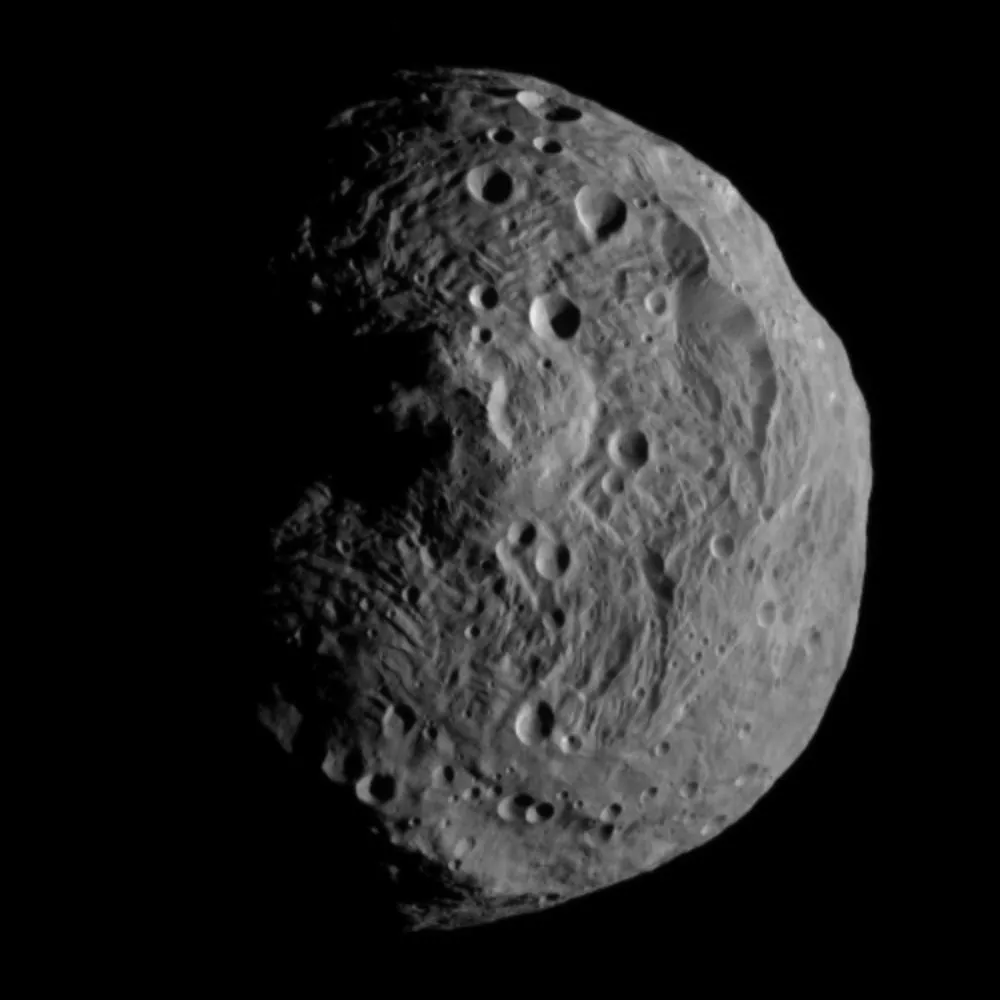
First image from orbit from 16,000 km away, July 17, 2011
HED Parent Body and Vesta
NWA 16018 belongs to the HED meteorite clan, which comprises howardites, eucrites and diogenites.
The HED meteorites are widely interpreted as originating from the differentiated asteroid 4 Vesta. This interpretation is supported by mineralogical, chemical and isotopic similarities between the meteorites and Vesta, together with the close spectral relationship established through observations by NASA’s Dawn spacecraft.
Vesta underwent extensive igneous differentiation early in Solar System history, producing a metallic core, an ultramafic mantle and a basaltic crust. The different HED lithologies sample different parts of this differentiated system.
Howardites are particularly important because they contain mixtures of material from different levels and lithologies of the HED crust. They can therefore preserve a more heterogeneous record of the parent body’s surface and shallow interior than many individual eucrites or diogenites.
NWA 16018 should consequently be regarded as material from the HED parent-body system, generally associated with Vesta, rather than as material from a primitive undifferentiated asteroid.
Howardite-Melt Breccia
The classification Howardite-melt breccia describes an important distinction from a conventional fragmental howardite.
A typical howardite consists primarily of mixed eucritic and diogenitic material. NWA 16018 contains this polymictic component but additionally preserves a substantial recrystallized impact-melt matrix.
This makes the meteorite particularly useful for studying the interaction between brecciation, impact melting and recrystallization in the HED system.
Impact-melt-bearing howardites have been used to investigate the history of large impacts on Vesta. Their melt components can preserve information about impact conditions and, where suitable minerals are available, can provide chronological constraints on individual impact events.
NWA 16018 does not, however, have a published impact age that should be assigned to the meteorite as a whole. The presence of an impact-melt matrix establishes the occurrence of impact melting, but does not by itself provide a numerical age for the event.

Shock and Weathering
NWA 16018 has a high shock stage.
The high shock classification indicates that the meteorite experienced substantial shock metamorphism associated with impact processing. This is consistent with its petrographic character as an impact-melt breccia.
Shock metamorphism and impact melting are related but distinct phenomena. Shock effects describe the physical and mineralogical modifications produced by high-pressure shock waves, whereas impact melting requires temperatures high enough to produce actual silicate melt.
The meteorite has a weathering grade of W2, indicating a relatively low degree of terrestrial alteration according to the standard weathering classification used for ordinary meteorites.
The recovered material consists of seven dark grayish fragments without fusion crust.
The absence of fusion crust should not be confused with the absence of impact melting. Atmospheric entry and impact melting are entirely separate geological processes. The melt matrix of NWA 16018 formed on its parent body during an impact event long before the meteorite reached Earth.
Geological History
The geological history recorded by NWA 16018 can be reconstructed in several stages.
First, the HED parent body underwent extensive igneous differentiation. This produced distinct lithologies including basaltic eucritic rocks and pyroxene-rich diogenitic rocks. The different mineral compositions preserved in NWA 16018 represent material derived from this differentiated system.
Subsequent geological and impact processes fragmented and mixed these lithologies. The presence of diogenetic pyroxene, ferroan low-Ca pyroxene, augite and calcic plagioclase demonstrates that the material incorporated into the breccia was mineralogically heterogeneous.
A later high-energy impact generated silicate melt. Rock fragments, basaltic clasts and individual mineral grains became incorporated into this melt. Some of the mineral grains were partially resorbed at their margins during interaction with the melt.
The melt subsequently cooled and recrystallized to produce the finely crystalline matrix now surrounding the clasts.
The final result is a polymictic impact-melt breccia that preserves both the differentiated geological history of the HED parent body and a later record of energetic impact processing.
References
- Gattacceca, J. et al. (2024). The Meteoritical Bulletin, No. 112. Meteoritics & Planetary Science, 59, 1820–1823.
- Meteoritical Bulletin Database. Northwest Africa 16018 — Official Entry.
- Cohen, B. A. et al. (2013). The Vestan cataclysm: Impact-melt clasts in howardites and the bombardment history of 4 Vesta. Meteoritics & Planetary Science, 48, 771–785.
- Mittlefehldt, D. W. et al. (2013). Composition and petrology of HED polymict breccias: The regolith of (4) Vesta. Meteoritics & Planetary Science.
- McSween, H. Y. et al. (2014). Asteroid (4) Vesta: I. The howardite-eucrite-diogenite (HED) clan of meteorites. Geochemistry, 74.