- Name: Northwest Africa 15915 (NWA 15915)
- Classification: Achondrite — ungrouped, Mg-rich clinopyroxenite
- Petrological character: Highly reduced, differentiated achondrite
- Parent body: Unknown; possible genetic affinities to the aubrite–enstatite meteorite reservoir
- Total Known Weight: 2.84 kg
- Found: Algeria
- Reported find location: Near Aougrout, Algeria
- Year found: 2023
- Official classification: Meteoritical Bulletin No. 112
- Shock stage: Low
- Weathering grade: Low
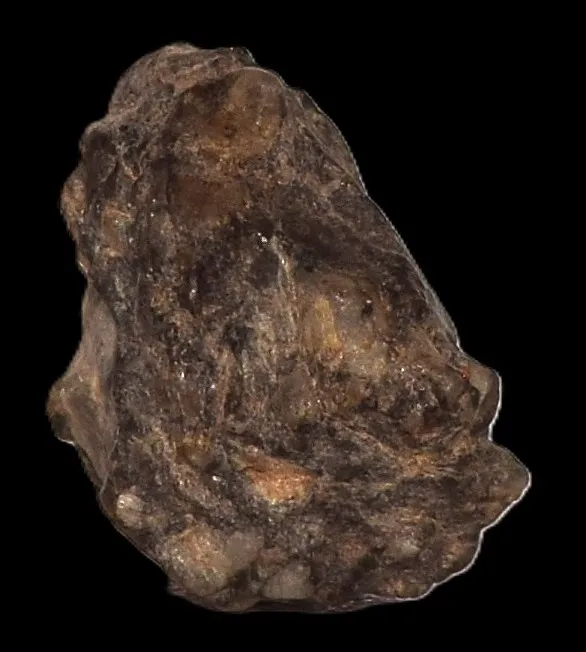
Small 1 g fragment of the NWA 15915 meteorite
Northwest Africa 15915 (NWA 15915) is an exceptionally unusual ungrouped achondrite officially classified as a Mg-rich clinopyroxenite. The Meteoritical Bulletin records a total known mass of 2.84 kg distributed among four stones. The material was reportedly found near Aougrout, Algeria. The largest stone was acquired from the finder in October 2022 and subsequently divided; three additional stones from the same reported location were acquired in May 2023. The meteorite was officially approved on 30 July 2023 and its classification was published in Meteoritical Bulletin No. 112.
NWA 15915 is distinguished by an extremely unusual mineral assemblage dominated by nearly iron-free augite, accompanied by Mg-rich enstatite and several reduced sulfide phases. Its coarse-grained, apparently unbrecciated igneous texture indicates crystallization within a parent body rather than formation as an ordinary chondritic aggregate. The meteorite does not fit into any established achondrite group and therefore remains classified as ungrouped.
The term ungrouped achondrite should not be interpreted as meaning primitive. NWA 15915 is regarded as a differentiated, highly reduced igneous meteorite. Its mineralogy records extensive high-temperature processing and crystallization within a parent body that had undergone significant chemical differentiation.
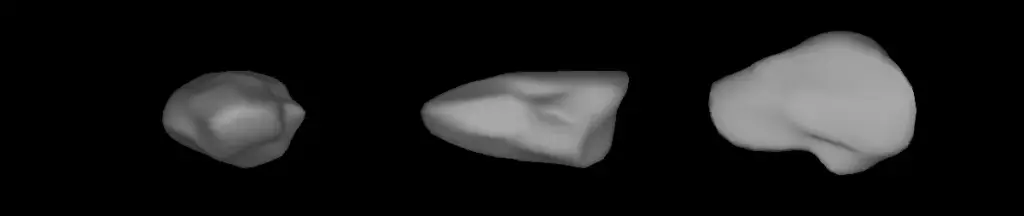
A possible asteroidal analogue is the E-type asteroid (3103) Eger, which has been proposed as a potential source of aubrite meteorites.
Computed non-convex 3D model of (3103) Eger.
Mineralogy and Geochemistry
The defining mineralogical characteristic of NWA 15915 is the overwhelming dominance of Fe-poor clinopyroxene.
The original Meteoritical Bulletin description characterizes the meteorite as a coarse-grained, protogranular aggregate with an average grain size of approximately 2 mm. It consists predominantly of homogeneous, almost end-member augite containing sparse, very thin exsolution lamellae of enstatite. Discrete enstatite grains constitute approximately 10 vol.% in the original classification material. Accessory phases include daubréelite, alabandite, troilite, minor low-Ni kamacite and secondary iron oxide. The Bulletin reported no olivine or plagioclase in the examined material.
Subsequent investigation of a different section has provided a more detailed modal mineralogy. Mitchell et al. reported approximately:
- 76.7 vol.% augite
- 20.2 vol.% enstatite
- 1.1 vol.% K-rich plagioclase
- 1.8 vol.% Fe metal
- approximately 0.2 vol.% daubréelite
- approximately 0.1 vol.% troilite
- less than 0.1 vol.% alabandite
The difference between the original Bulletin description and later analyses is important: the Bulletin material was reported as lacking plagioclase, whereas later analysis identified minor K-rich plagioclase in the investigated section. This demonstrates that the modal mineralogy may vary between portions of the meteorite and that statements concerning complete absence of a minor phase should be tied to the specific analyzed specimen.
The augite is extraordinarily magnesium-rich and iron-poor. In the 2025 study it has an approximate composition of:
Fs₀.₁Wo₄₂.₆
with Ca/(Ca+Mg) of approximately 0.55.
The enstatite has an approximate composition of:
Fs₀.₁Wo₁
These compositions demonstrate the extremely low Fe content of the silicate minerals.
The official Bulletin measurements give somewhat broader ranges:
Augite: Fs₀.₀–₀.₁Wo₃₇.₅–₄₃.₃
Enstatite: Fs₀.₁–₀.₃Wo₀.₅–₃.₂
The FeO concentration measured in augite is only 0.02–0.08 wt.%.
This extreme depletion in FeO is a key characteristic of NWA 15915 and indicates formation under strongly reducing conditions.
Fragment of NWA 15915 under the microscope
Pyroxene Exsolution
Enstatite occurs both as discrete grains and as thin lamellae within augite.
The 2025 compositional study found that the exsolution is particularly developed toward the interiors of augite grains and becomes less pronounced toward their rims. This distribution suggests that exsolution was not necessarily complete when the material was removed from its parent body.
The pyroxene assemblage therefore records a thermal history involving crystallization at high temperature followed by cooling and partial subsolidus re-equilibration.
The unusual dominance of calcic, nearly Fe-free augite distinguishes NWA 15915 from typical aubrites, which are predominantly composed of enstatite. Nevertheless, the chemical and isotopic similarities between NWA 15915, aubrites and enstatite chondrites are significant.
Reduced Sulfide Mineralogy
A particularly important feature of NWA 15915 is its unusual assemblage of reduced sulfide minerals.
Detailed investigation of 23 sulfide spherules and inclusions identified:
- alabandite (MnS)
- daubréelite
- troilite (FeS)
- oldhamite (CaS)
- caswellsilverite
- rare Fe metal
These phases occur predominantly as rounded, spherical inclusions within pyroxene or in interstitial positions between silicate grains. Individual inclusions range from submicrometre dimensions to more than 1 mm.
The spherical morphology is consistent with the interpretation that the inclusions originated as immiscible sulfide liquid droplets trapped during crystallization of the silicate assemblage. Subsequent cooling produced polyphase sulfide aggregates.
The identification of oldhamite (CaS) is particularly significant. Oldhamite is characteristic of highly reduced meteoritic environments and occurs prominently in enstatite chondrites and aubrites. NWA 15915 therefore shares a highly unusual chemical characteristic with these meteorite populations.
Caswellsilverite, reported in these sulfide inclusions, is likewise an unusual reduced sulfide phase. Together, the sulfide assemblage provides strong mineralogical evidence for formation under exceptionally reducing conditions.
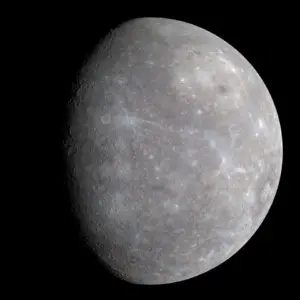
Mercury in natural colors, imaged by the MESSENGER spacecraft on January 14, 2008
Petrography
NWA 15915 is an unbrecciated, coarse-grained igneous rock with a plutonic texture. The analyzed material consists predominantly of millimetre-scale pyroxene grains.
The 2025 study describes grain sizes of approximately 2–3 mm and identifies a mineral assemblage dominated by Fe-free augite and Fe-free enstatite, with sulfides and rare feldspar. Olivine was absent from the analyzed section in that study.
The coarse-grained texture indicates relatively slow crystallization and cooling within the parent body. It is therefore more consistent with a cumulate or plutonic lithology than with a rapidly quenched volcanic melt.
Importantly, NWA 15915 does not exhibit the extensive brecciation and impact-melt textures characteristic of many eucrites or other impact-processed achondrites. Recent work likewise emphasizes the absence of significant shock effects.
Oxygen Isotopes
Oxygen-isotope data are central to understanding the possible parentage of NWA 15915.
The official Meteoritical Bulletin reports, from an acid-washed subsample analyzed by laser fluorination:
δ¹⁷O = +3.369‰
δ¹⁸O = +6.470‰
Δ¹⁷O = −0.035‰
using a terrestrial fractionation line with a slope of 0.526.
A subsequent study by Rider-Stokes et al. obtained slightly different values from its analyzed material:
δ¹⁷O = +2.931‰ and +2.908‰
δ¹⁸O = +5.572‰ and +5.498‰
Δ¹⁷O = +0.011‰ and +0.026‰
with the corresponding uncertainty reported in the study.
These differences should not be treated as a simple contradiction. They derive from different analytical datasets and analyzed portions of the meteorite. For scientific accuracy, the values should therefore be attributed to their respective studies rather than combining them into one definitive oxygen-isotope composition.
Both datasets place NWA 15915 close to the terrestrial fractionation line (TFL) and within or close to the isotopic field associated with enstatite chondrites and aubrites. This is one of the strongest indications of a genetic relationship with the highly reduced inner-Solar-System meteorite reservoir.
Relationship to Aubrites and Enstatite Meteorites
NWA 15915 has significant mineralogical and isotopic affinities with aubrites and enstatite chondrites.
These meteorites are characterized by extremely reducing formation conditions and FeO-poor or essentially FeO-free silicates. They also contain unusual sulfides that are uncommon or absent in most other meteorite groups.
NWA 15915 nevertheless differs from typical aubrites in an important respect: it is dominated by calcic clinopyroxene (augite) rather than enstatite.
A 2024 Meteoritical Society study proposed that NWA 15915, Ksar Ghilane 022 and related highly reduced augite-rich achondrites may represent previously unrecognized cumulate lithologies related to the aubrite parent-body reservoir, extending that mineralogical spectrum toward highly calcic, augite-rich compositions.
This interpretation remains a genetic hypothesis, not a formal reclassification. NWA 15915 remains officially classified as an ungrouped achondrite.
Parent Body
The parent body of NWA 15915 is not known.
This is an essential distinction. NWA 15915 has not been assigned to a specific asteroid or planet, and no confirmed parent body has been identified.
Its highly reduced mineralogy, oxygen-isotope composition and sulfide assemblage indicate formation in an environment chemically related to the enstatite–aubrite reservoir of the inner Solar System. The meteorite may therefore represent a previously unsampled differentiated body or an unusual lithology from a body related to the aubrite parent-body population.
The absence of significant shock metamorphism has also been used to argue against requiring an extremely large planetary parent body. One 2024 study suggested that the lack of shock effects may be more compatible with a smaller asteroidal parent body, although this remains an interpretation rather than a demonstrated constraint.
Possible Mercury Analogy
NWA 15915 has attracted particular scientific interest because some characteristics resemble those expected for highly reduced regions of Mercury.
Its Fe-poor silicates and unusual sulfides, including oldhamite, are compatible with formation under strongly reducing conditions. Laboratory spectra obtained from NWA 15915 and the closely related Ksar Ghilane 022 show unusual spectral properties associated with their iron-deficient mineralogy.
However, the current scientific evidence does not establish a Mercurian origin.
The 2025 Icarus study concluded that NWA 15915 and Ksar Ghilane 022 may constitute useful mineralogical analogues for portions of Mercury’s surface, but considered it unlikely that they are actual fragments of Mercury.
This distinction is scientifically important:
NWA 15915 is not a confirmed meteorite from Mercury.
Instead, it represents an unusually reduced differentiated planetary material that may provide a natural laboratory analogue for certain highly reduced lithologies on Mercury.
The existence of a confirmed meteorite originating from Mercury remains unproven.
Spectral Properties
Rider-Stokes et al. investigated the ultraviolet, visible and near-infrared spectral properties of NWA 15915 and Ksar Ghilane 022.
NWA 15915 exhibits a largely unusual spectrum with a much weaker spectral signature than would normally be expected from a pyroxene-rich rock. The study found a broad feature extending approximately from 575 to 950 nm, together with a steep ultraviolet slope. The authors attribute the weak spectral expression partly to the extremely low iron content of the silicates.
Unlike Ksar Ghilane 022, which was assigned a D-type-like spectral behavior based on its very red slope, NWA 15915 did not fit any Bus-DeMeo asteroid taxonomic class in the analyzed dataset and was therefore considered indeterminate.
These results demonstrate that highly Fe-depleted silicate surfaces can have spectral properties that differ substantially from those expected from conventional pyroxene-bearing asteroids.
Magnetic Properties
NWA 15915 has also been investigated for its magnetic properties.
The 2025 LPSC study detected magnetic phases associated primarily with the minor metallic and sulfide components. The authors reported evidence consistent with possible thermal remanent magnetization and discussed its potential implications for magnetic fields associated with the parent body during differentiation.
These results are preliminary and should not be interpreted as definitive evidence for a specific parent-body size or magnetic history. Nevertheless, they raise the possibility that NWA 15915 may preserve information about the thermal and magnetic evolution of its differentiated parent body.
Age and Early Solar System Evolution
NWA 15915 has been investigated using Pb-isotope systematics in the context of its formation age.
The available data have been interpreted as indicating an age of approximately 4.53 billion years, placing the rock among the oldest differentiated materials known from the Solar System. However, the age determination has analytical limitations and should not be presented as an absolutely established crystallization age.
The importance of the result is nevertheless clear: if the interpreted age reflects crystallization of the pyroxene-rich lithology, differentiation of its parent body occurred extremely early in Solar System history.
This is consistent with the broader model of rapid planetesimal differentiation driven by short-lived radionuclides such as ²⁶Al, which could melt and differentiate small planetary bodies within the first few million years after Solar System formation.
Terrestrial Weathering
The Meteoritical Bulletin assigns NWA 15915 a low weathering grade and low shock stage. The recovered stones are pale yellowish externally, with portions of black fusion crust. Fresh interiors are predominantly beige and somewhat friable.
Later investigations show that terrestrial weathering preferentially affected the larger, more exposed sulfide spherules. Smaller sulfide inclusions enclosed within pyroxene are considerably better protected from terrestrial alteration and can retain much more pristine mineralogical information.
The presence of secondary iron oxides in the meteorite is consistent with terrestrial alteration of originally reduced Fe-bearing phases.
Geological Interpretation
The most conservative interpretation of NWA 15915 is that it represents a highly reduced, differentiated, pyroxene-rich igneous lithology from an unknown parent body.
Its coarse-grained texture indicates relatively slow crystallization. The dominance of nearly Fe-free augite and subordinate enstatite indicates crystallization from an extremely reduced silicate system. Subsequent cooling produced partial exsolution of enstatite from augite.
The sulfide assemblage records immiscible sulfide liquids that crystallized alongside the silicate minerals under highly reducing conditions.
The resulting rock is therefore best interpreted as a pyroxene-rich differentiated cumulate or plutonic lithology, although the exact crystallization environment and position within the parent body remain unknown.
Scientific Significance
NWA 15915 is scientifically important because it represents a mineralogical and geochemical combination that is not adequately represented by the established meteorite groups.
Its principal significance lies in several characteristics:
- an exceptionally Mg-rich and Fe-poor clinopyroxene assemblage
- a coarse-grained, unbrecciated igneous texture
- extremely reducing mineral chemistry
- unusual sulfides including oldhamite and caswellsilverite
- oxygen-isotope characteristics close to the enstatite–aubrite reservoir
- possible evidence for magnetic recording during parent-body evolution
- potential relevance as a mineralogical analogue for highly reduced regions of Mercury
- an apparent formation age in the earliest history of the Solar System
The meteorite also demonstrates that the range of differentiated asteroid compositions is considerably broader than represented by the major established achondrite groups.
NWA 15915 is therefore best described as a highly reduced, differentiated, ungrouped achondrite (Mg-rich clinopyroxenite) of unknown parentage, with strong chemical and isotopic affinities to the enstatite–aubrite reservoir and possible relevance to the mineralogical evolution of Mercury-like planetary bodies.
It should not currently be described as a Mercury meteorite, an aubrite, or a primitive achondrite. Its official classification remains Achondrite (ungrouped, Mg-rich clinopyroxenite).
References
- Gattacceca, J. et al. (2024). The Meteoritical Bulletin, No. 112. Meteoritics & Planetary Science, 59, 1820–1823. Official classification and characterization of NWA 15915.
- Mitchell, J. T., Brown, M. B. & Feinberg, J. M. (2025). Preliminary Compositional and Magnetism Analysis of Northwest Africa 15915, an Unusual Ungrouped Achondrite. 56th Lunar and Planetary Science Conference, Abstract #2035.
- Dickens, D. & Bell, A. S. (2024). Oldhamite Bearing Sulfides in a New Ungrouped Achondrite. 86th Annual Meeting of the Meteoritical Society, Abstract #6440.
- Bell, A. S. et al. (2024). NWA 15915, Ksar Ghilane 022 and related highly reduced augite-rich achondrites. 86th Annual Meeting of the Meteoritical Society, Abstract #6209.
- Rider-Stokes, B. G. et al. (2025). Insights into pyroxene-dominated surfaces and implications for ongoing space exploration missions. Icarus, 441, 116713.
- Meteoritical Bulletin Database. Northwest Africa 15915 — Official Entry.