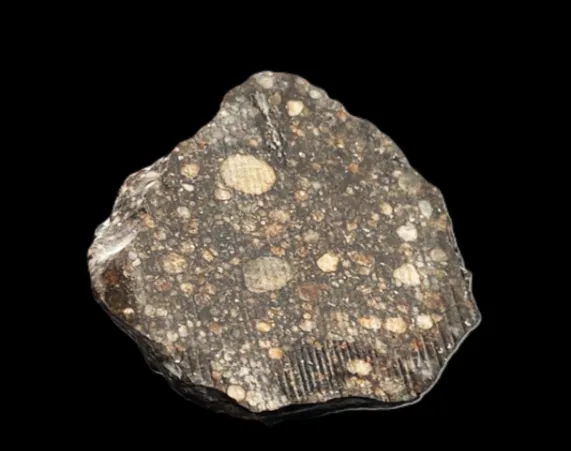
A dense distribution of sharply defined chondrules across the polished surface.
• Name: NWA 13566
• Classification: LL4 ordinary chondrite (shock darkened, S3, W1)
• Origin: LL ordinary chondrite parent body (asteroidal parent body)
• Total Known Weight: 826 g
• Found: Northwest Africa
• Discovery Date: 2020
NWA 13566 is an LL4 ordinary chondrite discovered in Morocco in 2020. The meteorite has a total recovered mass of 826 g and was classified based on its petrographic characteristics, mineral chemistry, and magnetic properties. NWA 13566 belongs to the LL group of ordinary chondrites, which are characterized by relatively low abundances of metallic iron compared with H and L chondrites.
The meteorite is classified as shock stage S3, indicating that it experienced moderate shock metamorphism on its parent body. It is also classified as weathering grade W1, showing only minor terrestrial alteration after its fall to Earth. The available scientific data describe NWA 13566 as a relatively well-preserved ordinary chondrite with retained chondritic features.
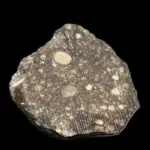
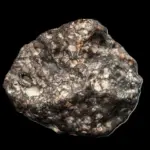
Polished cut surface revealing the interior, with the opposite side retaining its unaltered exterior surface (weight: 24 g)
Mineralogy
The mineralogy of NWA 13566 is consistent with an LL ordinary chondrite. The main silicate phases are olivine and low-calcium pyroxene, accompanied by plagioclase, troilite, chromite, apatite, pentlandite, and minor iron–nickel metal.
Electron microprobe analyses determined an average olivine composition of Fa35.3 ± 0.7 and a low-calcium pyroxene composition of Fs28.0 ± 3.6 Wo1.2 ± 0.5. These mineral compositions are consistent with classification within the LL chondrite group.
Metallic iron–nickel occurs only in small amounts, with an abundance of less than one percent. The presence of troilite and other sulfide phases is typical for ordinary chondrites and reflects the original mineral assemblage of the parent material.
Petrography
Petrographically, NWA 13566 displays a typical chondritic texture consisting of chondrules embedded within a fine-grained matrix. The average apparent chondrule diameter is approximately 640 µm.
The meteorite contains fine iron sulfide veins and opaque mineral phases. Plagioclase occurs as isolated grains within the matrix. The observed texture is consistent with an LL4 classification, in which the original chondritic material experienced moderate thermal metamorphism while retaining recognizable chondrules.
Shock Metamorphism and Formation
NWA 13566 is classified as shock stage S3. This indicates that the meteorite experienced moderate shock effects caused by impact processes on its parent body.
The shock effects include shock darkening, which results from the redistribution of opaque phases such as metal and sulfides within the meteorite. However, NWA 13566 does not show evidence of extensive impact melting and remains classified as an ordinary chondrite rather than an impact melt rock.
Terrestrial Weathering and Age
The terrestrial weathering grade of NWA 13566 is W1, indicating only minor chemical alteration during its time on Earth. Primary minerals remain largely preserved, and only limited oxidation of metal-bearing phases has occurred.
A terrestrial residence age has not been published for NWA 13566. Therefore, the exact duration of its exposure on Earth is currently unknown.
Scientific Significance
NWA 13566 represents a documented example of an LL4 ordinary chondrite. Its preserved chondritic structure, mineral composition, low weathering grade, and recorded shock history provide information about the characteristics and alteration processes experienced by ordinary chondrite parent bodies.
As an LL4 chondrite, NWA 13566 contributes to the study of ordinary chondrites and provides additional material for understanding the composition and evolution of asteroid parent bodies in the early Solar System.
References
• Meteoritical Bulletin Database. Official classification and nomenclature of Northwest Africa 13566 (NWA 13566). The Meteoritical Bulletin, The Meteoritical Society.