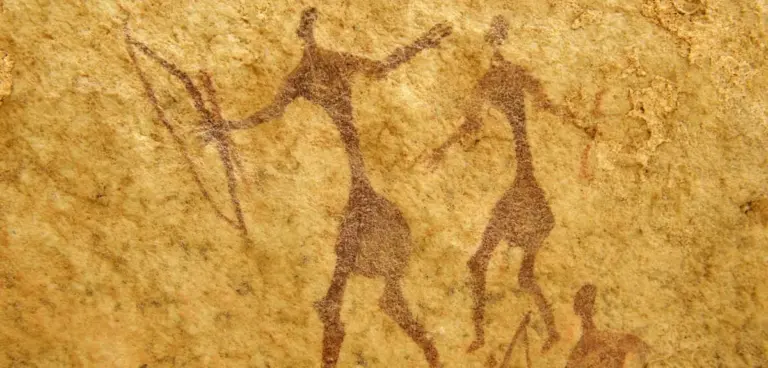
The image originates from Neolithic rock paintings in Tin Meskis, Algeria.
The Stone Age refers to the oldest and longest period in human history. It is characterized by the use and production of stone tools and spans a timeframe of approximately 2.6 million years until the beginning of the Metal Ages, in Central Europe roughly until around 2200 BCE.
The Stone Age represents a formative phase in human evolution, during which successive hominin species developed increasingly sophisticated cultural and technological capacities. Across species such as Homo habilis, Homo erectus, Neanderthals (Homo neanderthalensis), and later Homo sapiens, stone tool production played a central role in adaptation and survival. This technological continuity reflects both cognitive development and long-term responses to changing environmental conditions.
Stone tool technologies evolved from simple flaking techniques producing basic cutting edges to more controlled methods involving prepared cores, allowing for the systematic production of blades with standardized forms. Over time, tool production became more structured, with increasing attention to efficiency, repeatability, and functional specialization.
In addition, tools were increasingly produced as composite implements, combining stone with organic materials such as wood or bone. This expanded their functional range and indicates a growing complexity in planning and production processes.
Archaeological evidence also shows increasing regional diversification in technological traditions. Different populations developed distinct approaches to tool production, shaped by environmental conditions, available resources, and culturally transmitted knowledge systems.
Later developments are associated with fundamental changes in subsistence strategies. The emergence of food production through agriculture and animal domestication led to more permanent settlement patterns, greater spatial organization of daily activities, and more complex forms of social coordination.
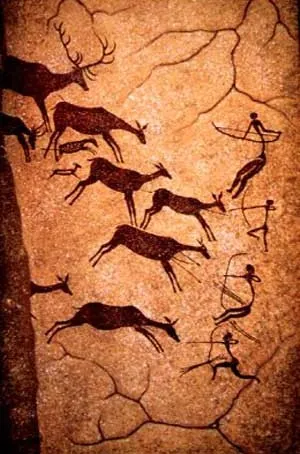
Stone Age rock paintings from the Valtorta Valley in Spain