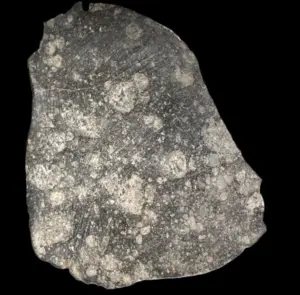
Achondrites originate from asteroids and planetary bodies whose interiors were heated over long periods of time, causing their rocky material to become molten. In this state, the original solid rock loses its rigid structure, and the mineral components are able to move freely and rearrange themselves. As a result, distinct regions form within these bodies where materials of different composition separate, such as metal-rich zones or silicate-rich rocks. This process leads to achondrites lacking original, unaltered primary structures such as chondrules, instead representing rocks that have already been transformed and differentiated.
The group of achondrites can be further subdivided into several main groups that reflect their mineralogical composition, texture, and the degree of internal processing experienced by their parent bodies. Unlike chondrites, they no longer preserve primitive chondrules, as their original structures were modified or erased during melting and igneous reworking. These classifications are based on detailed petrographic observations, chemical compositions, and isotopic signatures, which allow the identification of distinct formation histories and parent bodies. The classification is based on petrographic, chemical, and isotopic criteria, while further subdivisions within these groups are defined by more detailed differences in mineralogy, texture, and geochemical signatures. The classification is as follows:
Primitive Achondrites
Differentiated Achondrites
Planetary Achondrites

Mars in natural colors, captured by the Al-Amal spacecraft.